
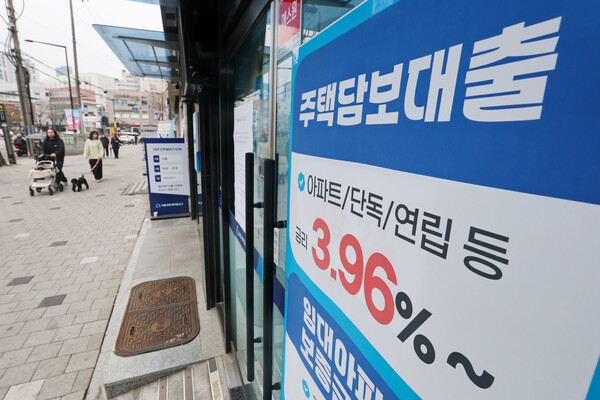
Mortgage loan rates rose for a fifth straight month last month.
Bank of Korea data released on Thursday showed the weighted-average interest rate on new mortgage loans by deposit banks in February rose 0.03 percentage point from the previous month to 4.32 percent a year. It marked the highest level in 2 years and 3 months since November 2023, when it was 4.48 percent.
By contrast, the overall household loan rate fell 0.05 percentage point from the previous month to 4.45 percent. The rate on general unsecured credit loans, which carry higher interest rates, fell 0.02 percentage point to 5.53 percent from 5.55 percent, and their share within household lending also declined.
Lee Hye-young (이혜영), head of the financial statistics team at the central bank, said the five-year bank bond yield, a benchmark for mortgages, rose 0.15 percentage point in February, but the increase was limited because the share of fixed-rate lending with higher interest rates declined. She said credit loan rates fell as some banks reduced the share of lending to mid- and low-credit borrowers despite a rise in short-term bank bond yields, a benchmark for those loans.
The share of fixed-rate lending within mortgage loans fell 4.5 percentage points in a month to 71.1 percent from 75.6 percent. The share of fixed-rate loans in total household lending also fell 3.9 percentage points to 43.1 percent from 47 percent.
Corporate loan rates rose 0.05 percentage point from the previous month to 4.20 percent a year in February. Rates for large firms rose 0.04 percentage point to 4.13 percent, while those for small and medium-sized firms rose 0.07 percentage point to 4.28 percent.
The overall bank loan rate for households and firms combined rose 0.02 percentage point to 4.26 percent.
The rate on new savings deposits rose 0.05 percentage point from the previous month to 2.83 percent a year, rebounding after a month. The rate on pure savings deposits rose 0.03 percentage point to 2.80 percent, while the rate on market-rate financial products rose 0.15 percentage point to 2.97 percent.
As the rise in deposit rates outpaced loan rates, the gap between loan and deposit rates based on new transactions narrowed 0.03 percentage point to 1.43 percentage points. The gap based on outstanding balances widened 0.02 percentage point to 2.26 percentage points.
One-year time deposit rates at non-bank financial institutions rose as follows: mutual savings banks to 3.05 percent, credit unions to 2.94 percent, mutual finance cooperatives to 2.76 percent and community credit cooperatives to 2.98 percent. They rose 0.05 percentage point, 0.10 percentage point, 0.02 percentage point and 0.10 percentage point, respectively.
Loan rates rose at mutual savings banks to 9.58 percent, up 0.14 percentage point, mutual finance cooperatives to 4.38 percent, up 0.03 percentage point, and community credit cooperatives to 4.45 percent, up 0.05 percentage point. Rates at credit unions fell 0.01 percentage point to 4.54 percent.
 Ji-young Lee
ljy@d-today.co.kr
Ji-young Lee
ljy@d-today.co.kr