
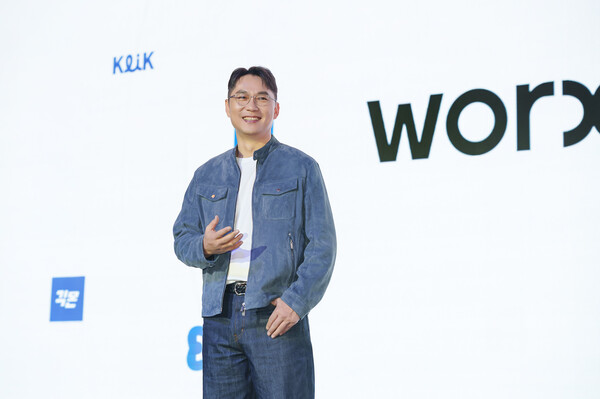
The venue of the JOBKOREA THE REBOOT conference held by JobKorea in late January to mark its 30th anniversary.
Near the end of his keynote speech, JobKorea CEO Yoon Hyun-joon (윤현준) summed up the company’s vision and raised the provocative theme of the “dismantling of the resume”. It symbolised that a hiring process that needs resumes does not fit the vision JobKorea is pursuing.
He repeatedly stressed that he wants to change the hiring experience by building an HR platform centred on AI- and data-based digital profiles, rather than resumes, and to reshape the industry through that. According to him, resumes are a product of the analogue era dominated by standardised documents.
With AI now able to understand people and grasp relationships, replacing resumes with digital profiles is not just a slogan but an option that is already feasible.
Digital profiles provide predictability about careers based on various forms of information that AI can understand, known as multimodal data. They do not end after being created once, but become increasingly personalised based on data. This can go beyond simple information to include context and narratives about specific users, which is difficult with resumes alone.
Yoon said, “A resume is checking someone’s past. The hiring side has to judge based on which school they attended, what they majored in and what their career has been so far. When people intervene and judge in a situation without context and narratives about the individual, uncertainty and errors arise.” He made clear that, from the perspective of the hiring experience, a generational shift from resumes to digital profiles is needed and that JobKorea will lead it.
JobKorea reborn as Worksphear... “Opening a new world of work with AI agents”
Digital profiles are core infrastructure underpinning “connection”, a keyword JobKorea emphasises in its next-generation HR platform strategy. The company says higher-quality digital profiles can also improve the quality of connections between job seekers and jobs, industries and people. Yoon sees a serious imbalance in connections in the hiring platform market.
Yoon said, “Applicants flock to some companies, but there are also many firms that do not get applicants even if they advertise. Companies are finding it hard to hire people, and uncertainty is growing. From the job seeker’s perspective, it is no longer an era where you decide on a company based only on fame. People consider whether it fits their capabilities, values and life patterns, and whether they can perform the role well once they join. Platforms have to solve these problems. To do that, the level of connection has to rise. We will become a platform that connects companies with the people most likely to fit.”
Data is the core of connection, which Yoon calls the essence of JobKorea’s business. He said he believes technology can solve connection problems because he has confidence in data. Yoon said, “JobKorea has large-scale quantitative data accumulated over 30 years. But it was hard to grasp the context behind that data, and as AI has evolved it has now become possible. AI and software engineers with experience at major domestic platform companies are joining to make the vision a reality.”
JobKorea also operates various platforms that address work-related issues, including Albamon, Ninehire, Nook and Clip for hiring foreign workers. It recently acquired corporate information service JobPlanet. The JobPlanet acquisition is also part of its strategy to advance connections. Yoon said, “It has meaning beyond a simple acquisition in that it can combine quantitative data and qualitative data. It will help the platform evolve to understand the context behind the numbers.”
JobKorea is also rolling out details of its connection strategy. At the JOBKOREA THE REBOOT conference, it unveiled 2 AI-based next-generation career agents that it will introduce sequentially in the first half of 2026. The company said the AI career agents are designed to go beyond simple condition matching, understand the situations and contexts facing individuals and companies, and suggest the next choices.
The Talent Agent is an inference-based conversational talent search service for HR staff. If an organisation enters its situation and the type of talent it needs in natural language, AI analyses past hiring data and internal and external talent information to suggest the best candidates. Its key feature is that it is an AI agent that understands hiring context beyond simple resume searches. Yoon said, “Talent Agent connects not only to Worksphear but also finds and connects talent pools outside. There is no need to move around multiple platforms.”
The Career Agent is a hyper-personalised career recommendation service for job seekers. It analyses behavioural data such as job posting views, application history and activity patterns to proactively suggest opportunities suited to the individual. Yoon said, “We implemented a hiring experience that goes beyond the era when everyone looked at the same postings, delivering only the most meaningful information to each individual.”
JobKorea developed Context Link, its proprietary AI matching technology, to implement Talent Agent and Career Agent.
The company said Context Link aims to deliver AI that understands jobs and people in a three-dimensional way. It is focused on connecting companies with the people most likely to fit. Yoon said, “Quantitative data makes it difficult to grasp context and intent. Context Link is an AI connection model that analyses based on a large language model and an inference engine,” adding, “It enables understanding of context and narratives through multidimensional vectors.”
JobKorea Smart Fit and the Hiring Center are also services that apply Context Link. Smart Fit is a performance-based model that sets advertising fees based on companies’ hiring outcomes, calculating costs based on actual applicant inflows rather than charges based on ad exposure. Under a click-based billing structure, where costs arise only when job seekers click a posting, companies can freely register or stop postings. Yoon said, “Through Smart Fit, we are making sure ads are shown to suitable people. We are getting feedback that it is producing meaningful applicants.”
The Hiring Center, to be introduced in the first half of 2026, is an integrated business centre for companies. It addresses the inconvenience of having to manage full-time and non-regular hiring on separate platforms, and provides an all-in-one hiring environment that enables everything from posting registration to applicant management and hiring performance analysis through a single channel. Yoon said, “They will be able to register postings, manage applicants and discover talent in one place.”
 Chi-gyu Hwang
delight@d-today.co.kr
Chi-gyu Hwang
delight@d-today.co.kr