
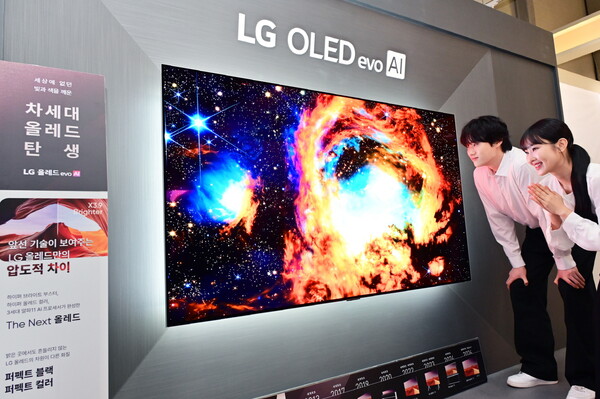
LG Electronics is moving to defend its lead in the premium market with its 2026 OLED TV lineup, combining its brightest-ever display with ultra-low reflection technology. With Chinese companies turning away from the OLED market, it is betting on structural scarcity as a weapon.
LG Electronics on March 25 held a briefing on its 2026 TV lineup at Ground220 in Seoul's Yangpyeong-dong and unveiled its “The Next OLED” range.
The key strength of the lineup is its Hyper Radiant Color technology. It combines the third-generation Alpha11 AI Processor 4K Gen3 with its ultra-low reflection technology, Reflection Free Premium, to deliver up to 3.9 times the brightness of a standard OLED TV (B6 model). The third-generation Alpha11 processor, with AI performance improved 5.6 times, also converts low-quality content into 4K using “AI Dual 4K Upscaling,” in addition to brightness and colour rendering.
It also differentiated its reflection reduction approach from existing products. Unlike conventional anti-glare technology, which scatters and diffuses light and causes image-quality loss, it reduces reflection to about half by extinguishing the light itself. It was the first in the industry to obtain Intertek’s Reflection Free Premium certification.
On sound, it supports Dolby Atmos FlexConnect to deliver immersive audio regardless of speaker placement. Linked with LG Electronics’ home audio system, LG Sound Suite, it provides a theatre-level sense of space. AI TV features have also been strengthened.
It also includes Microsoft Copilot and Google Gemini on the webOS26 smart TV platform, offering a multi-AI search system that users can choose from. On its art content service, LG Gallery+, users can create and enjoy paintings and background music using generative AI.
LG Electronics also unveiled 2 new form factors. The wireless wallpaper TV, the LG OLED Evo W6, has a thickness in the 9 mm range and houses all components, including the panel, power board and speakers, and applies technology that wirelessly transmits 4K 165 Hz video and audio without loss. It previously won top product awards from multiple overseas media at CES 2026. The MicroRGB Evo is a premium LCD TV that earned triple 100 percent colour certification by combining red, green and blue LED light sources with the third-generation Alpha11 AI processor.
Domestic shipment prices, based on 65-inch models, range from 3.29 million won (B6) to 3.79 million won (C6); for 77-inch models, from 5.69 million won (B6) to 8.70 million won (G6); and for 83-inch models, from 7.90 million won (B6) to 13.0 million won (G6). The wireless wallpaper TV (W6) and MicroRGB TV are scheduled for release in the first half of this year.
OLED annual supply under 10 million units... structural scarcity as a premium defence wall
Baek Sun-pil (백선필), an executive director in charge of display CX at LG Electronics’ MS Business Division, set out the company’s position on the controversy over OLED price competitiveness. Baek said there are only 2 companies in the world that supply OLED panels for TVs: LG Display and a domestic rival. He said combined annual production capacity of the 2 is under 10 million units. That is only 5 percent of annual global TV sales of about 200 million units. Baek said there will be no rapid mass-market shift in OLED prices.
He also outlined a direction for cost reduction. Rather than lowering panel grades, the company is taking a technology-based approach to cut costs by reducing heat generation through upgrades to its proprietary power circuit (DPC) chip and by reducing the amount of heat-dissipation materials such as aluminium. Baek said, “Lowering the price by lowering quality is not capability.” He added, “The higher the power efficiency, the lighter the materials can be used, so there is still room for cost reduction going forward.”
He also set out the company’s position on moves toward a TCL-Sony partnership. Baek said, “TCL has hardware capabilities but is weak in picture-quality control chips, and Sony overlays algorithms on external chips without its own chips.” He added, “LG Electronics has accumulated more than 10 years of OLED optimisation algorithms on its own chips, maintaining an edge in picture-quality control.”
 Daegeon Seok
d2dg@d-today.co.kr
Daegeon Seok
d2dg@d-today.co.kr