
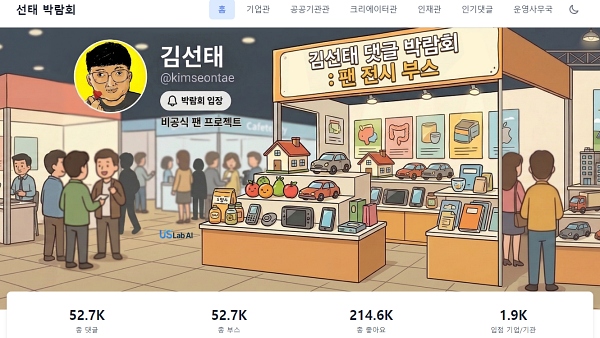
[DigitalToday intern reporter Yu Seung-a] On March 9, AI consulting firm USLab.ai unveiled Seontae Expo, a web service that reconstructs comments on Kim Sun-tae’s YouTube videos into an exhibition-hall format.
It turns into a web service, using artificial intelligence (AI), a joke by people who said the roughly 50,000 comments on Kim’s videos looked like a job fair. As an environment emerges in which ideas can be implemented quickly without specialised knowledge, it shows that who makes something into a form first is becoming as important as what someone came up with.
Behind it was the rapid spread of Kim’s YouTube channel. On March 3, Kim Sun-tae (김선태), a former Chungju city civil servant known as “Chungju Man,” opened his personal channel “Kim Sun-tae” after leaving his job. The channel drew more than 1.4 million subscribers in just 10 days and became a major talking point. The comment section also drew attention as much as the videos did. Public institutions, corporate public relations staff and individual users flooded into the comments, sparking what was dubbed a “marketing war.”
In one example, a comment left by Woori Bank that read, “IU, Jang Wonyoung, T1, Kim Sun-tae let’s go,” later led to Kim’s first advertising tie-up. On March 20, the Kim Sun-tae channel uploaded a video titled “Woori Bank promotion.” It also drew a strong response, recording 4.54 million views. It shows comments can function as a venue for promotion and networking beyond simple interaction.
Lee Sun-young (이선영), a director at USLab.ai who created Seontae Expo, explained in an interview with DigitalToday that she viewed the comment section not as a simple trend but as a structural scene where messages from multiple players are mixed and revealed.
“It looked like a space where companies, public institutions, individuals and creators each display their own messages, so I thought we should redesign it into an expo structure,” she said. “As self-introductions, collaboration proposals and job-seeking flows emerged in ordinary user comments, it became clear this project was not a simple collection but a reconstruction,” she added.
Seontae Expo does not stop at simply gathering and showing comments. It draws attention by turning a joking expression into an actual structure. Comments are displayed in separate areas such as a public institution hall, a corporate hall and a talent hall, and users can browse content as if exploring a digital expo.
“It was impressive to see the moment when comments changed from ‘data’ to an ‘exhibition.’”
The implementation used several generative AI tools including ChatGPT, Gemini, Cursor AI and OpenClaw. AI was applied throughout the process, from collecting comments and designing classification rules to building a data pipeline, designing the UI and revising code. It underscores that generative AI is being used as a tool involved in planning, design and production overall, beyond merely explaining results.
Speed is also noteworthy. Lee said, “One internal person led the project and built the first prototype in about 8 hours.” A post introducing Seontae Expo on an online community also drew a comment saying, “It’s a bit scary to hear the person who made this isn’t a developer. At this level, aren’t they basically a developer?”
Rapid implementation did not necessarily mean completeness. Lee said it took more time to refine it into a state that could actually be operated, including correcting classification accuracy, handling exceptions and fixing bugs. “Even if AI increases development speed, setting direction and managing quality are still a human role,” she said. She explained that building something quickly and completing it into an operable state are separate issues.
Recently, so-called “vibe coding,” in which people quickly build prototypes by giving instructions to AI in natural language, has also been spreading. Seontae Expo is an example showing that the use of generative AI is expanding beyond generating answers and assisting searches to a stage where people’s observations and ideas are structured and moved into an actual service.
Separately, USLab.ai said it is operating an archive that collects and analyses 452 CES 2026 Innovation Award-winning entries and provides them as a web service. It added that it has recently been working on summarising presentations and industry trends from the Game Developers Conference (GDC) 2026.
 Yu Seung-a
ysah@d-today.co.kr
Yu Seung-a
ysah@d-today.co.kr