
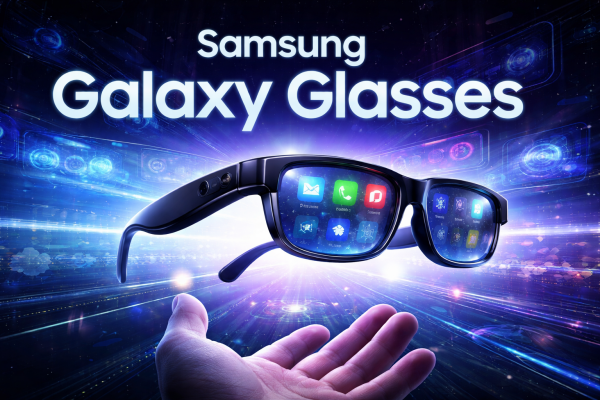
[DigitalToday reporter Jinju Hong (홍진주)] Leaked key specifications for Samsung Electronics' smart glasses, Galaxy Glasses, which it has flagged for launch within the year, are raising market expectations.
Tech outlet TechRadar reported on March 23 that Samsung plans to introduce an Android XR-based device by the end of this year. The product is also likely to be unveiled together with an XR headset, it said.
Hardware specifications are drawing the most attention. The latest leak suggests Galaxy Glasses will carry a roughly 245 mAh battery, similar to Ray-Ban Meta smart glasses. Some material also raises the possibility of 2 models. Analysts say they could be split into a basic version without a display and a higher-end model with a display, Galaxy Glasses Ultra. Model numbers also leaked separately as SM-0200P (standard) and EB-0200 (Ultra).
The camera is another key point. The glasses are expected to include a roughly 12-megapixel camera, with uses expected to go beyond simple shooting and be tied to artificial intelligence functions. A representative feature is context awareness that analyses the surrounding environment and provides information based on the user's field of view. It has broad scope, including navigation, object recognition and real-time information.
On the software side, integration with the Android XR ecosystem is central. According to leaked code, some apps may operate in an XR environment, and major services such as music streaming are also expected to be supported. The initial model, however, is expected to be more dependent on a smartphone than a standalone device. With no separate communications function, it would use a smartphone's computing power, a strategy aimed at reducing battery burden and making the device lighter.
In design and user experience, whether to apply transition lenses is also a focus. Lenses that automatically adjust brightness depending on indoor and outdoor environments could significantly increase usefulness, but nothing has been confirmed so far.
The industry sees Galaxy Glasses as more likely to establish itself as an auxiliary device at first rather than fully replacing a smartphone. Even so, it is seen as having ample potential to change the smart device paradigm in the future as XR and AI functions are combined.
 Jinju Hong
hongjj@d-today.co.kr
Jinju Hong
hongjj@d-today.co.kr