
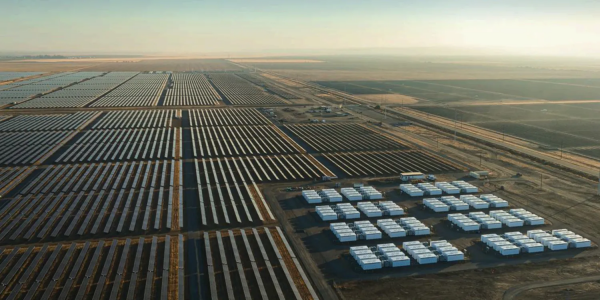
Tesla is making a large investment push as it seeks to build 100 gigawatts of solar manufacturing capacity in the United States.
A Reuters report cited by electric-vehicle outlet Electrek on March 20 said Tesla CEO Elon Musk (일론 머스크) is negotiating with Chinese companies to bring in about $2.9 billion of solar production equipment. Suzhou Maxwell Technologies has been mentioned as a key supply candidate, and some equipment could be delivered to a Texas plant as early as this fall. The timetable could depend on whether the Chinese government approves exports.
The investment is directly linked to Musk's goal of producing 100 GW of solar annually, which he announced at the World Economic Forum. That is more than three times the total U.S. solar installations in 2023, at about 32 GW, and is an unusual scale for a single company. Tesla plans to internalise the entire supply chain from raw materials to finished panels to build an independent production system.
Rising power demand underpins the strategy. As AI data centres expand and electric vehicles become more widespread, U.S. electricity consumption is setting record highs, and Musk has stressed solar as the most realistic alternative to meet it.
Tesla has struggled in its solar business in the past. The Solar Roof project pursued after its 2016 acquisition of SolarCity fell short of expectations, and installations continued to decline. The solar division, once seen as a core business, has effectively lost its presence.
In contrast, its energy storage business has grown rapidly. Tesla deployed 46.7 gigawatt-hours of energy storage systems in 2025 and posted $12.8 billion in revenue. That showed higher profitability than its auto business and has become a new growth engine. The solar expansion strategy is interpreted as an attempt to build an integrated energy business spanning generation, storage and supply by combining solar with storage devices such as Megapack and Powerwall.
Risks remain. Tougher Chinese export controls and U.S.-China technology frictions add uncertainty to bringing in equipment. Past failures in the solar business also leave markets largely cautious.
The industry says the feasibility of the 100 GW goal can be judged only after confirming actual facility construction and production-line operations. Attention is on whether the investment will remain a verbal vision or become a turning point that remakes Tesla into an energy company.
 Jinju Hong
hongjj@d-today.co.kr
Jinju Hong
hongjj@d-today.co.kr