
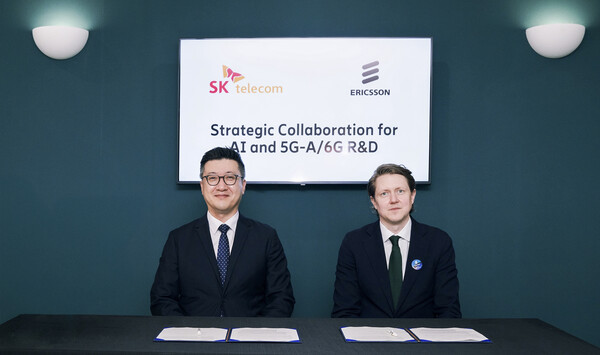
SK Telecom is joining hands with Ericsson to prepare for the 6G era through artificial intelligence-based network innovation.
SKT said on March 19 it signed a memorandum of understanding with Ericsson to strengthen cooperation on AI-based network technologies from 5G to 6G.
Under the agreement, the two companies will build a cooperation framework for the continued evolution of network technology. They plan to pursue practical application of innovative technologies in 5G environments and lay the groundwork for long-term 6G research and standardisation.
The agreement focuses on joint research and verification of advanced network technologies. The scope of cooperation spans AI-based radio access networks, 5G upgrades, open and autonomous networks, security, 6G standardisation and future technologies.
Through cooperation on AI-RAN, the two companies will pursue improvements in network performance, security and energy efficiency. AI-RAN is a technology that optimises networks by having them learn and predict channel conditions, enabling more efficient resource management.
They also plan to create new business opportunities through advances in 5G technology and lay the foundation for implementing next-generation services.
In open and autonomous networks, they will conduct research to automate network operations. The goal is to boost productivity and operational efficiency even in multivendor environments where equipment from multiple manufacturers operates together.
In security, they will strengthen protection of networks and devices across 5G and 6G environments, based on a zero-trust system and continuous monitoring, and advance capabilities to respond to real-time threats. Zero trust refers to a security model that does not basically trust any access, without distinguishing between inside and outside the network.
The two companies will also expand cooperation on 6G standardisation and future technologies. This includes spectrum strategy, evolution of extreme multiple-input multiple-output technology, energy efficiency technologies, and integrated sensing and communication that combines communications and sensing.
Extreme multi-antenna technology uses multiple antennas to increase data transmission efficiency and network capacity. ISAC refers to technology that uses communications signals to sense the surrounding environment and identify location and movement information.
Ryu Tak-ki (류탁기), head of network technology at SKT, said cooperation with Ericsson will be a key driver of AI-based network evolution and an important foundation for moving toward the 6G era. He said SKT will secure world-leading technology leadership in AI-based network evolution and 6G through global standardisation and research centred on demonstrations.
 Jin-ho Lee
jhlee26@d-today.co.kr
Jin-ho Lee
jhlee26@d-today.co.kr