
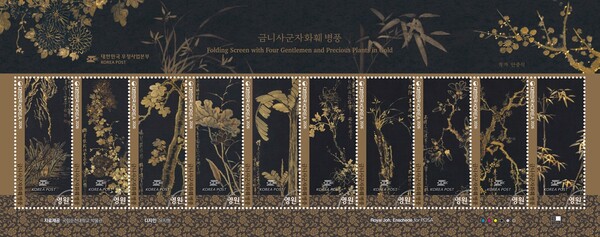
The Ministry of Science and ICT’s Postal Service said on March 18 it will issue 400,000 commemorative stamps in 10 designs featuring the Gold Pigment Four Gracious Plants and Flowers folding screen on March 26.
The commemorative stamps feature a 10-panel folding screen made in 1901 by Ahn Jung-sik (안중식). Ahn is known as a master in the calligraphy and painting world linking the traditional and modern art circles in the late Joseon period, and is known as the last court painter at the royal Dohwaseo.
The Gold Pigment Four Gracious Plants and Flowers folding screen commemorative stamps will be issued as permanent stamps. Permanent stamps do not show a face value, so even if postage rates change, mail weighing more than 5 grams and up to 25 grams can always be sent without paying an additional fee.
The Gold Pigment Four Gracious Plants and Flowers folding screen held by the museum of the National University of Suncheon depicts plant forms in gold pigment on a black silk background. Gold pigment is an ink made by mixing finely crushed gold leaf with animal glue. It takes on a subtle sheen when it catches the light. Ahn added flowers including magnolia, peony, Japanese banana, lotus, paulownia and daffodil to the Four Gracious Plants of plum blossom, orchid, chrysanthemum and bamboo, composing each panel with precision.
The Postal Service explained that the stamps express the distinctive subtle sheen of gold pigment, and that the golden flowers and trees in the stamps allow people to feel the breath of Korea’s modern art.
 Jin-ho Lee
jhlee26@d-today.co.kr
Jin-ho Lee
jhlee26@d-today.co.kr