
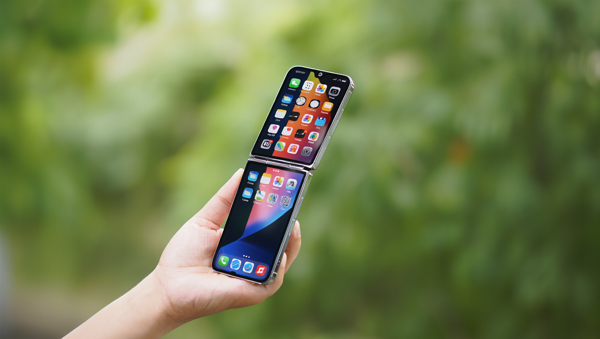
[DigitalToday intern reporter Kyoungmin Hong (홍경민)] Apple appears likely to temporarily delay the launch of its flip-style foldable iPhone and focus on a strategy to strengthen profitability in the second half of this year around the high-priced iPhone Fold and Pro lineup. This is seen as more than a simple schedule change, reflecting Apple’s management approach of maximising profits by steering demand toward high-performance, high-priced models.
PhoneArena, an IT media outlet, reported on Feb. 18 that rumours are spreading in the industry that Apple has put its production plan for its first foldable phone, the flip-style iPhone, on hold. The rumour suggests the flip-style iPhone may not be available until 2027 or 2028, much later than the market had expected.
A strategic judgement by Apple focused on profit lies behind the delay decision. Apple is preparing its first book-style foldable model, currently referred to as the iPhone Fold. It plans to unveil it alongside its next flagship lineup, the iPhone 18 Pro and iPhone 18 Pro Max, scheduled to be introduced in September.
That aligns with a decision to intentionally push back the launch of a flip model that is likely to be priced relatively lower, and to concentrate consumer attention on the new high-priced foldable model and the top-end Pro lineup.
This strategic lineup reshuffle also directly affects consumers’ buying patterns. With the standard iPhone 18 also expected to be delayed until early 2027, consumers who want to upgrade to the latest smartphone are likely to choose the high-priced Pro series or a premium foldable model that can be bought immediately, rather than waiting for a lower-priced model. Apple is effectively using the timing gap to raise the sales share of higher-priced models and secure maximum profit.
On technical completeness, Apple is also seeking to take the initiative in the market by putting the iPhone Fold ahead of a flip-style iPhone. A source said Apple is focused on minimising the crease, a chronic issue for foldable phones that has drawn mocking criticism in the market. While it is nearly impossible to eliminate the mark entirely due to the foldable structure, Apple aims to prove a technical edge by delivering a screen that is much flatter and thinner than rival products.
To that end, the iPhone Fold is expected to adopt next-generation display technology called CoE (Color Filter on Encapsulation) OLED. CoE technology can make the panel significantly thinner by removing the polariser film and instead integrating the colour filter directly into the encapsulation layer. It can also deliver much higher brightness with the same power, becoming a key competitive strength for high-priced foldable models that need both power efficiency and visual immersion.
Market experts say Apple’s moves will help short-term profitability but leave something to be desired in expanding the foldable market. Book-style foldables provide a vast screen area about 3 times that of regular smartphones, optimised for multitasking and professional media consumption, but heavy weight and a high price barrier are obstacles.
By contrast, the delayed flip-style iPhone, with a flip design that fits easily into a pocket or small bag, maximises portability. It also evokes nostalgia for past flip phones and could be the strongest card to draw younger consumers into the foldable market.
As a result, Apple is expected to stick to a “highest-price policy” throughout 2026 and focus all its efforts on monopolising profit in the premium market through the iPhone Fold and the Pro series. Whether the flip-style iPhone is ultimately launched is expected to be a key variable determining not only Apple’s brand share but also the pace at which foldables become mainstream in the overall smartphone market.
 Kyoungmin Hong (홍경민)
hongm@d-today.co.kr
Kyoungmin Hong (홍경민)
hongm@d-today.co.kr