
SK Telecom is accelerating companywide artificial intelligence transformation, or AX. Under the catchphrase “Change we make together, AX,” it plans to support all employees in developing AI agents themselves and pursuing business innovation beyond automating existing work.
On March 16, SKT shared internally a detailed roadmap including the opening of a support system and employee training, alongside a goal of “one AI agent per person” in which every employee, including non-developers, builds AI tailored to their own work.
SKT will provide platforms including A.Dot Biz, which it described as highly versatile, Polaris, specialised in marketing and data extraction, and Playground, which helps with network data analysis and coding. Employees can use the platforms to ask questions in natural language or combine modules to create AI agents for use in day-to-day work.
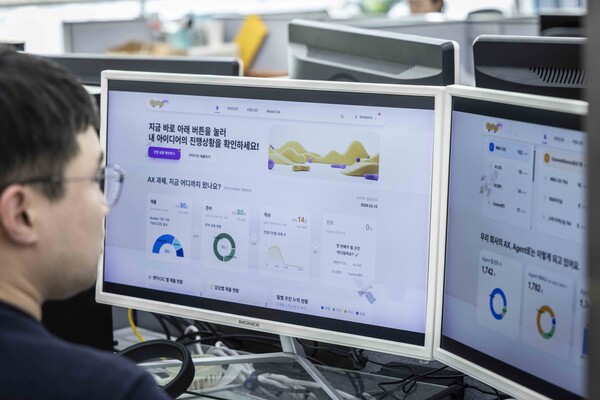
It also officially launched a support system called AXMS (AX Management System) on the day to help AX take root in corporate culture. AXMS discloses submitted innovation ideas, progress and feedback transparently to raise the use of in-house knowledge, and provides a dashboard that can be checked in real time.
SKT plans to continue AX idea contests and training throughout the year. About 180 submissions have been received for its AX innovation idea contest, which has been running since February. The company is selecting core projects for a fast track and is jointly developing them with practitioners and development departments, aiming for commercialisation and companywide rollout within the third quarter this year.
It will also run a step-by-step skills enhancement programme that includes frontier training, a design camp and a boot camp to boost employees’ practical use of AI. It will hold a hackathon in the first half to bring together innovation capabilities, and in the second half it will spread successful cases across the company through the selection of a second round of AX projects and awards for strong performance.
SKT has already applied AX success cases developed by employees to work. “Secure coding verification automation” has a function in which AI reviews coding to prevent errors and even suggests ways to fix them, cutting the manager’s work time by 30 percent a year. The location analysis solution LITMUS combined AI algorithms that infer traffic and footfall movement and modes of travel, leading to new business results including supply to local governments.
SKT CEO Jae-heon Jung (정재헌) said AI transformation begins not with flashy technology but with small improvements by employees who best understand the problems in their own workplaces. Attempts to solve inconveniences through AI will come together to become a strong driving force that turns SKT’s own AX flywheel, he said.
 Jin-ho Lee
jhlee26@d-today.co.kr
Jin-ho Lee
jhlee26@d-today.co.kr