
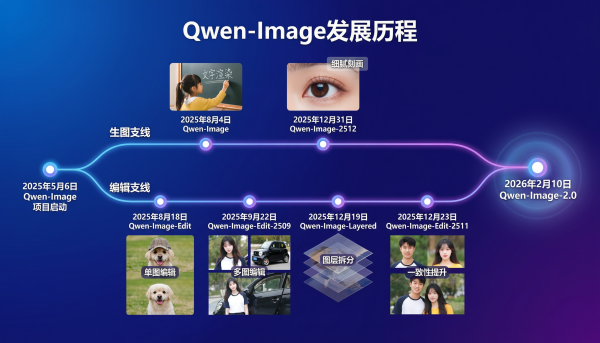
Alibaba's research team unveiled the image-generation artificial intelligence (AI) model Qwen-Image-2.0. The model combines Qwen-Image and Qwen-Image-Edit and is designed for realistic image generation and making images that include text.
On Feb. 12, the online media outlet Gigazine reported that Qwen-Image-2.0 received high marks in both text-to-image generation and image editing on Alibaba's AI blind test service, AI Arena. It outperformed Gemini-2.5-Flash Image Preview (Nano Banana) in text-to-image generation and showed a similar level of performance in image editing, the report said.
The model also emphasizes efficiency improvements. It supports 1,000-token inputs, allowing detailed adjustment of layout composition through prompts, and can generate slide-style images. It supports various styles, including photorealistic images, images containing long text, posters and information-dense slides. It also includes a comic-generation function.
Its use spans from photorealistic images to images containing long sentences, posters and information-dense slides. It supports generating comics by specifying panel composition, dialogue and layout. Its editing features have also been strengthened, making it possible to input a single portrait photo to generate images with various poses or to composite subjects from different photos into a single scene.
Qwen-Image-2.0 is currently available on Qwen Chat. Earlier Qwen-Image series models were released as open models, but the new model is not yet available for download.
Alibaba expanded image generation and editing capabilities with the new model and widened support to making images that include text. However, because the model's data has not been released, use is expected to focus for now on Qwen Chat.
As the new model has been introduced as producing results similar to Google's Nano Banana, some have raised the possibility that competition among image-generation models will intensify. Because images that include text and editing performance are areas with strong real-world impact, the extent of its influence is expected to vary depending on whether Qwen-Image-2.0 spreads first as a service or later broadens the development ecosystem through a model release.
 Yoonseo Lee
yslee@d-today.co.kr
Yoonseo Lee
yslee@d-today.co.kr