
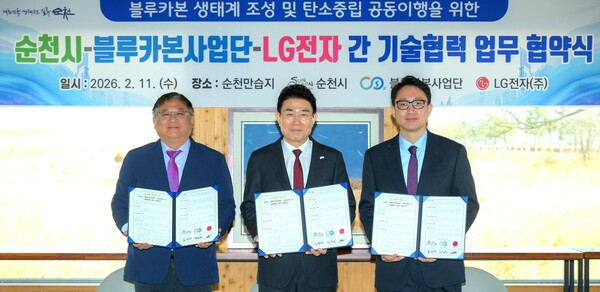
LG Electronics will move to restore the Suncheon Bay tidal-flat ecosystem using its new material, Marine Glass. LG Electronics said on Tuesday it signed a memorandum of understanding with Suncheon city and Seoul National University’s Blue Carbon project group at Suncheon city hall on joint implementation of a blue carbon ecosystem and carbon neutrality.
Under the agreement, LG Electronics will apply Marine Glass to about 1,500 square metres of the Suncheon Bay tidal flats, a UNESCO World Natural Heritage site. It will run a pilot project to verify the growth of salt marsh plants and the efficiency of carbon absorption. Blue carbon is carbon absorbed and stored by marine and coastal ecosystems. It absorbs carbon faster than terrestrial ecosystems and has greater storage capacity.
Marine Glass is a functional glass material independently developed by LG Electronics that turns into mineral ions when it comes into contact with water. It supplies minerals needed for the growth of seaweed and salt marsh plants at a set amount and rate. LG Electronics has secured technology to control the precise dissolution of mineral components.
Marine Glass can be made in the desired type, quantity and form. In areas with fast currents, it is produced as spherical beads or flat chips. It is made hard and heavy so the mineral components do not disperse easily. LG Electronics plans to expand the scope of cooperation by creating salt marsh plant habitats within the Suncheon Bay tidal flats and building a long-term ecosystem management model.
LG Electronics is fostering a new business-to-business business by researching, developing and commercialising new glass-powder-based materials. With Seoul National University’s Blue Carbon project group, it is working on discovering new projects and jointly developing technology to revitalise the blue carbon industry at home and abroad. With the National Water Industry Cluster project group and the Korea Water Forum, it is also carrying out a pilot project to verify the washing performance of the Mineral Wash detergent and its water and power saving effects.
LG Electronics first applied functional glass powder to ovens launched in the North American market in 2013. It has filed 420 patents related to glass powder so far. Based on this, it is expanding its portfolio, including Purotec, an antibacterial and antifungal material that suppresses microbial odours and contamination when added in small amounts to plastic, paint and rubber, and Mineral Wash, a laundry material that replaces surfactants in detergents.
Kim Young-seok (김영석), head of LG Electronics’ HS Functional Materials Business Office, said, "We will strengthen competitiveness by developing a sustainable new materials business while contributing to environmental conservation and solving carbon issues."
 Seok Dae-geon
d2dg@d-today.co.kr
Seok Dae-geon
d2dg@d-today.co.kr