
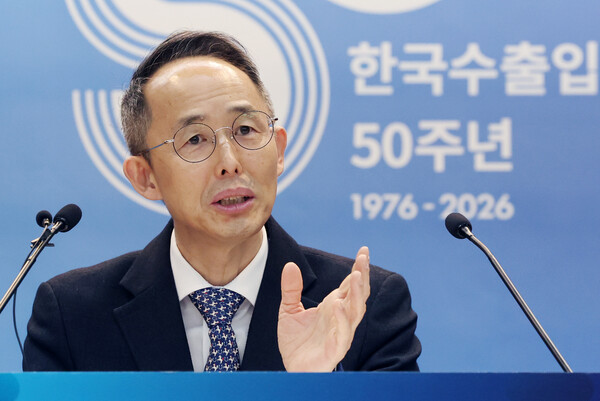
Hwang Ki-yeon (황기연), CEO of the Export-Import Bank of Korea, said on Tuesday that the purpose of establishing the bank is “productive finance”. He said he will strengthen inclusive finance so that, while pursuing productive finance, its benefits spread to regional small and mid-sized exporting companies.
He outlined a plan to focus policy capacity on building an industrial ecosystem that encompasses local small companies, alongside large-scale support for strategic industries centered on big companies.
At a news conference marking his 100th day in office at the Bankers Association Building in Jung-gu, Seoul, Hwang said he will overcome domestic and external uncertainty and secure global leadership in national strategic industries. He stressed he will pursue productive finance in parallel with inclusive finance.
He said large-scale financial support for areas such as nuclear power, defense and shipbuilding is difficult for the private sector to shoulder. He said the bank will work with commercial banks to drive productive finance.
The bank will 추진 an “Export Vitality ON (ON·溫) Finance Support Package” worth 150 trillion won from this year through 2030. It plans to provide 110 trillion won to small and mid-sized companies and expand the share of lending outside the Seoul metropolitan area to at least 35 percent. In the first half of this year, it will establish a regional-led growth fund for exporting small and mid-sized companies worth 1.3 trillion won.
It will also invest 22 trillion won in a special program for an artificial intelligence great transformation (AX), and support 50 trillion won over five years for securing source technologies and facility investment in advanced industries. It plans to supply 100 trillion won over five years to strategic order-winning industries such as defense, nuclear power and shipbuilding.
It will also operate a special lending limit of 50 billion won for small and mid-sized supply chain companies and create a 250 billion won critical minerals and energy fund to strengthen supply chain competitiveness.
Hwang said the bank is currently supporting about 45 percent of its total loans for projects related to developing countries. He said it will use policy finance and its global network to expand the economic territory.
 Ji-young Lee
ljy@d-today.co.kr
Ji-young Lee
ljy@d-today.co.kr