
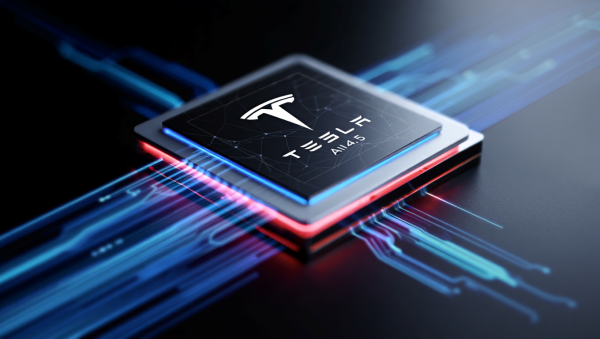
Tesla's development schedule for its next-generation artificial intelligence chip, AI6, has been delayed by about six months.
Electric, an electric-vehicle outlet, reported on March 12 that the release schedule for the AI6 chip, designed to run Tesla's self-driving vehicles, Optimus robot and AI datacentres, has been pushed back due to delays in Samsung Foundry's 2-nanometre process. South Korean semiconductor outlet The Elec reported that Samsung's multi-project wafer prototype run for its 2-nanometre process has been delayed by about six months, affecting chip development timelines for related customers.
The delay is affecting not only Tesla but also customers using the same process node. South Korean AI semiconductor startup DeepX has also seen its schedule slip for its DX-M2 AI chip, which was to be produced on Samsung's 2-nanometre process. The chip is an on-device generative AI chip that can run models of up to 100 billion parameters at about 5 watts. Mass production was initially expected in the second quarter of 2027, but quality testing is now expected to begin no earlier than the third quarter of 2027.
Tesla signed a contract worth about $16.5 billion with Samsung Electronics last year to produce the AI6 chip using a 2-nanometre gate-all-around process at Samsung's Taylor, Texas plant. The contract runs through 2033, and it was reported that Tesla initially secured capacity to produce about 16,000 wafers a month. Tesla has since been discussing a plan to expand that to about 40,000 wafers a month.
But delays in Samsung's preparation for the 2-nanometre process have raised the likelihood that the AI6 chip's actual commercial launch will also be pushed back. The industry believes it will be difficult to deploy the chip in Tesla vehicles or robots before 2028.
The issue is also affecting Tesla's semiconductor roadmap. Tesla has already postponed the schedule for mass production of its AI5 chip to mid-2027, and its dedicated self-driving vehicle, the Cybercab, is expected to launch on existing Tesla AI4 hardware.
The delay is also an important variable for Samsung's foundry business division. Samsung has been pushing the 2-nanometre process as a core strategy to catch up with TSMC in advanced-process competition, and it has positioned Tesla's AI6 chip production and HBM4-related logic dies as key growth drivers. But the delayed MPW run is seen as signalling that tasks remain to address issues such as process yield or technology maturity.
The industry has also pointed to a widening gap between Tesla's aggressive chip development schedule and the realities of semiconductor manufacturing. If commercialisation of key chips needed to run next-generation self-driving and robot technologies continues to be delayed as AI infrastructure investment expands, Tesla's AI strategy could face constraints to some extent.
 Jinju Hong
hongjj@d-today.co.kr
Jinju Hong
hongjj@d-today.co.kr