
LG Uplus is stepping up an “autonomous operating network” strategy to automate overall network operations. It applies artificial intelligence (AI) agents and digital twin-based technology to its commercial network to respond to network failures and overloads. It is a strategy to build a more efficient telecommunications operating system beyond the existing approach that relied on manpower.
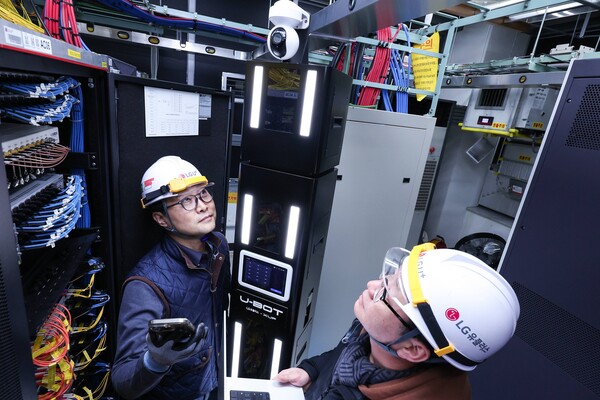
LG Uplus held a news conference on Monday at LG Science Park in Seoul’s Gangseo district and presented measures to shift the entire network operation process to an AI-based autonomous operating network, including failure and traffic management, wireless network optimisation and exchange-site management. It also introduced ways to apply digital twins, including collecting exchange-site environmental data using an AI autonomous driving robot.
◆ Failure handling and service quality management with AI agents
LG Uplus uses a platform for implementing an autonomous operating network called AION (Artificial Intelligence Orchestration Nexus). AION is a solution for automating repetitive tasks and establishing an AI-based response system. LG Uplus said mobile customer quality complaint filings fell 70 percent and home customer quality complaint filings fell 56 percent after introducing AION.
It also developed an AI agent specialised in network operations. It applies the AI agent to failure handling tasks to conduct 24-hour real-time monitoring. Previously, people checked alarms and responded, but the AI agent detects even minor abnormal signs and carries out remote processing or requests on-site dispatch. It can shorten the time needed to take action on failures.
It also uses an AI agent to detect service quality. The AI agent captures abnormal signals that occur during service use and finds quality problems that are difficult for people to notice. It then quickly analyses the problem area and automatically carries out network setting measures.
The AI agent also responds to sharp traffic fluctuations so base stations do not become overloaded. LG Uplus said that after applying the AI agent, even a novice engineer can automatically handle “traffic prediction → parameter adjustment → real-time monitoring → base station control” by entering only an intention in natural language.
◆ Collecting exchange-site data with AI autonomous driving “U-BOT”
LG Uplus also actively uses a digital twin model to build an autonomous network. It links analysis results derived from the digital twin to actual network operations to manage wireless quality more precisely.
It is currently running a proof of concept for automation technology by pilot-deploying an AI autonomous driving robot at exchange sites. The AI autonomous driving robot “U-BOT”, which uses LG AI Research’s AI “EXAONE”, collects information on equipment status, temperature and surrounding environmental conditions inside exchange sites and reflects it in the digital twin model.
System operators can use U-BOT to grasp equipment locations and status at a glance without visiting the site in person. Jun-hyuk Kwon (권준혁), head of LG Uplus’ network division and a vice president, said, “Because most are unmanned exchange sites, people had to be dispatched to check whether there was an abnormality.” He said, “We built a digital twin as a way to identify the situation at unmanned exchange sites as quickly as possible remotely.”
It also uses a digital twin for 5G wireless quality management. An AI agent detects and analyses wireless signal conditions and call volume changes in real time and automatically adjusts the range and direction of wireless signal transmission based on that. An LG Uplus official stressed, “Even if traffic concentrates in a specific area or a momentary drop in quality occurs, we quickly reflect the necessary measures to maintain stable call quality and data speeds.”
LG Uplus said it received a level 3.8 score, close to the top level 4.0, in the “access failure management” category in a network automation maturity assessment conducted by global telecommunications industry association TM Forum last year, the first among South Korean carriers. Seong-woo Park (박성우), an executive director in charge of NW solutions at LG Uplus, said the company would “raise the level step by step with safety in mind.”
LG Uplus will unveil AI- and digital twin-based network operations automation technology at the telecommunications exhibition MWC 26 in Barcelona, Spain, next month. It will introduce the technology to global telecommunications operators and explore cooperation and the possibility of global expansion.
Kwon said, “Through evolution to an autonomous operating network, we expect to be able to expand the standard of customer experience from existing ‘quality’ to ‘trust’.” He said, “We will continue to advance the core network technologies that customers need most to contribute to creating a safer and more sustainable society.”
 Jin-ho Lee
jhlee26@d-today.co.kr
Jin-ho Lee
jhlee26@d-today.co.kr