
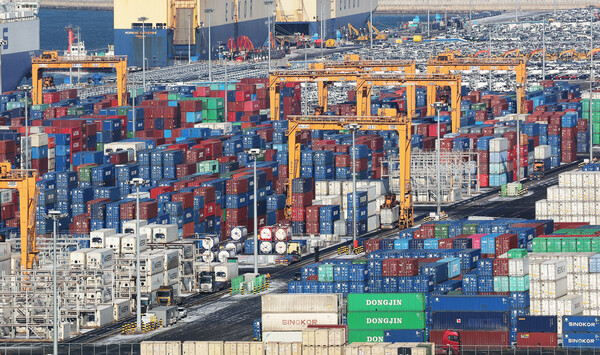
South Korea posted its biggest-ever surplus in international trade at more than $120 billion last year, helped by strong exports including semiconductors and higher dividend income from overseas investments.
Preliminary balance of payments data released by the Bank of Korea on Thursday showed the current account surplus for December totaled $18.7 billion, equivalent to about 27.5 trillion won. It was the largest on a monthly basis.
The cumulative current account surplus for the year came to $123.05 billion, about 180.6 trillion won. That surpassed the previous record of $105.1 billion set in 2015.
It was also more than $8 billion higher than the Bank of Korea’s forecast in November of $115 billion.
By component, the goods account surplus in December was $18.85 billion. It rose from $11.44 billion a year earlier and from $14.7 billion the previous month, also marking a record monthly surplus.
Exports of $71.65 billion rose 13.1 percent from a year earlier. By item, based on customs clearance, semiconductors rose 43.1 percent, computer peripherals climbed 33.1 percent and wireless communications devices gained 24 percent. By region, exports were strong to Southeast Asia, up 27.9 percent, China, up 10.1 percent, and the United States, up 3.7 percent.
Imports of $52.8 billion rose 1.7 percent. As energy prices fell, raw material imports slipped 1 percent, led by declines in petroleum products, down 35.2 percent, coal, down 20.9 percent, gas, down 7.6 percent, and crude oil, down 3.5 percent. Capital goods imports increased 5.8 percent, centered on semiconductors, up 10.4 percent, and information and communications devices, up 25.6 percent. Consumer goods imports rose 17.9 percent, led by gold, up 461.9 percent, and passenger cars, up 24.0 percent.
The services account posted a deficit of $3.69 billion. The deficit widened from $2.38 billion a year earlier and from $2.85 billion the previous month.
Within the services account, the travel account posted a deficit of $1.4 billion. The deficit widened from $970 million in November, and the Bank of Korea said it was because the number of departures increased during the winter school vacation season, a peak period for overseas travel.
The primary income account surplus jumped to $4.73 billion in December from $1.53 billion in November. The increase was driven mainly by a surge in the dividend income account surplus to $3.71 billion from $930 million.
Net assets in the financial account, assets minus liabilities, rose $23.77 billion in December.
In direct investment, residents’ overseas investment increased by $6.49 billion and foreigners’ investment in South Korea rose by $5.17 billion.
In portfolio investment, residents’ overseas investment increased by $14.37 billion, mainly in stocks, while foreigners’ investment in South Korea rose by $5.68 billion, mainly in bonds.
[Yonhap News Agency]
 Online Team
d-today@d-today.co.kr
Online Team
d-today@d-today.co.kr