
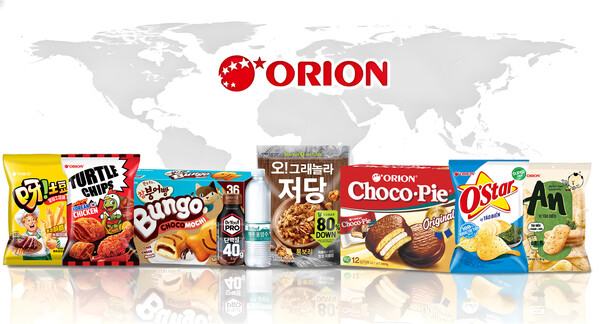
Orion said on Feb. 5 it posted 2025 consolidated sales of 3.33 trillion won and operating profit of 558.2 billion won. That was up 7.3 percent and 2.7 percent, respectively, from a year earlier. Growth in pie product sales in Russia and India led overall results.
Orion said it continued to increase sales based on product strength and sales capabilities even without the holiday-season effects of the Lunar New Year in China and Tet in Vietnam, the peak seasons in those markets. It said Russia posted growth of 47.2 percent and India 30.3 percent. Exports also rose as the company expanded markets to Europe and Africa, among others.
It also faced heavier manufacturing cost burdens due to poor harvests that pushed up prices for key raw materials such as cocoa, oils and fats, and nuts, as well as a weak currency. Orion said it defended profitability through operational efficiency.
By subsidiary, sales growth in Russia and India stood out.
The Russia unit posted sales of 339.4 billion won and operating profit of 46.5 billion won. That was up 47.2 percent and 26 percent, respectively, from a year earlier. It said establishing a multi-product lineup including Watermelon Choco Pie, Fresh Pie and jellies, and expanding dedicated products for large distribution channels, was effective despite manufacturing cost pressure from higher raw material prices and rising logistics costs.
The company said utilisation rates on five Choco Pie production lines in Russia exceed 140 percent and product supply is generally insufficient. It said it began construction last month of a new plant building in Tver after investing a total of 240 billion won. Once the new lines are completed, annual production will rise to 750 billion won, double the current level.
The India unit posted sales of 27.5 billion won, up 30.3 percent. It said 20-rupee products such as White Pie gained traction and a sales strategy focused on the northeastern region worked. This year, it will expand production lines for Choco Pie and Custard, which have strong growth potential, and continue to widen its customer base centered on the northeastern region. It also plans to step up its push into e-commerce channels to accelerate sales growth.
The South Korea unit posted sales of 1.15 trillion won and operating profit of 186.8 billion won, up 4.4 percent and 4.6 percent, respectively, from a year earlier. The company said sales rose due to the launch of new products reflecting trends and increased overseas export volumes, despite a difficult environment including weakened consumption and fewer customers. It said temporary costs from the recall of a Cham Bungeoppang product and higher raw material prices added to the burden. It also said royalties increased as overseas subsidiary sales rose and it cut costs.
This year, it plans to lead the market by launching health-oriented and premium products. It said it will strengthen its medium- to long-term growth base through construction of the Jincheon Integrated Center, with a total investment of 460 billion won.
The China unit posted sales of 1.32 trillion won, up 4 percent, and operating profit of 241.7 billion won. It said sales rose as it expanded dedicated products for high-growth channels such as snack stores and e-commerce, and launched new products including low-sugar Choco Pie, despite the absence of a peak-season effect from the Lunar New Year last year. Operating profit fell 0.9 percent due to increased marketing expenses from expanding small merchants dedicated to Zyman and higher raw material costs.
This year, the China unit will launch new health-oriented products and expand dedicated product operations for high-growth channels. It also plans to sustain growth by stepping up efforts at snack stores and convenience stores in high-growth central and southern markets such as Hangzhou and Guangzhou.
The Vietnam unit posted sales of 538.1 billion won, up 4.6 percent, while operating profit fell 3.6 percent to 96.5 billion won. It said this reflected strong sales in core categories such as snacks and pies despite the absence of a peak-season effect from Tet last year. Operating profit declined as key raw material prices rose and marketing expenses temporarily increased to widen the gap with the No. 2 player in the potato snack market, where competition has intensified.
This year, it will fully start operating new production lines for snacks and candy at the Hanoi Yen Phong plant and focus on expanding shelf share by distribution channel. It said rice crackers, which achieved sales of 68 billion won last year, will continue strong growth based on expanded production capacity. It also plans to complete Hanoi Plant No. 3 within the year and prepare construction of Ho Chi Minh Plant No. 4, for which it secured a site last year, to strengthen its medium- to long-term growth base.
An Orion official said, "This year, we expect the growth trend to strengthen as holiday effects such as the Lunar New Year and Tet, along with the effects of production line expansions we are pushing to expand product supply at home and abroad, begin to take full effect."
 Shin-hye Ahn
doubletap@d-today.co.kr
Shin-hye Ahn
doubletap@d-today.co.kr