
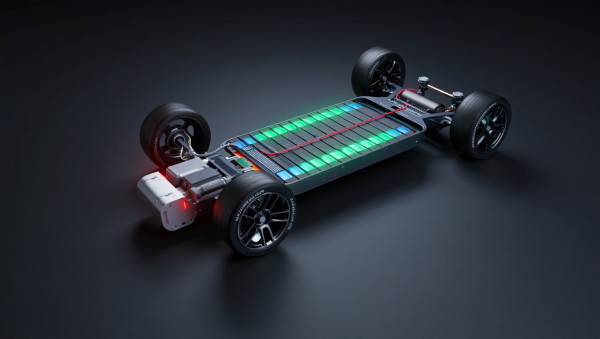
[DigitalToday reporter Jinju Hong (홍진주)] BYD's rise in Europe's electric vehicle market is no longer unusual. BYD is rapidly moving up sales rankings by using battery innovation to boost EV performance and cost competitiveness at the same time. At the centre is cell-to-body technology, which directly integrates the battery into the vehicle structure.
Sweden's Volvo has recently joined the technology lineup, making the competitive landscape clearer. Cleantechnica, an electric-vehicle outlet, reported the details on Feb. 3 (local time).
Cell-to-body integrates battery cells directly into the vehicle chassis without a separate battery pack. That cuts vehicle weight and secures interior space, while simplifying manufacturing processes to reduce costs. Tesla first presented the concept at its Battery Day in 2020, but BYD is seen as furthest ahead in commercialisation. BYD has improved energy density and body rigidity at the same time with the structure and has succeeded in mass production.
The technology is also drawing attention in academia. Researchers at Chalmers University of Technology in Sweden have studied the concept of using batteries as structural components since 2007 and in 2021 proposed the idea of a "massless battery" for electric vehicles. The approach aims to cut overall vehicle weight, size and cost at the same time by giving structural rigidity to the battery pack's outer container and the cells themselves.
In subsequent research, the Chalmers team proposed using carbon fibre as a load-bearing electrode material instead of aluminium foil. Carbon fibre simultaneously serves as reinforcement, a current collector and an active material in the cathode, and becomes a structural base where lithium can accumulate in the anode. The team sees it as a way to raise rigidity and energy density at the same time and enable faster charging cycles. The research is continuing with support from the Swedish National Space Agency and the Wallenberg Initiative Materials Science for Sustainability (WISE).
Among automakers, Volvo is leading commercialisation of cell-to-body technology along with BYD. Volvo promoted up to 810 km of driving range and ultra-fast charging through its next-generation electric SUV EX60 unveiled on Jan. 19. The vehicle can charge about 340 km in 10 minutes on a 400 kW fast charger, and it combined a cell-to-body structure with mega casting to maximise energy efficiency. Volvo called the EX60 a "game changer" for the EV market and said its strategy is to ease both range and charging anxiety at the same time.
Tesla, which first presented the cell-to-body concept, has recently failed to show clear progress in battery innovation. Updates have effectively stopped since the first Battery Day in 2020, and delays to the Cybertruck launch and controversy over discontinuing the Model S and X have made the direction of its battery strategy unclear. Some in the industry also expect Tesla could fall behind in the next-generation battery race as BYD and Volvo lead cell-to-body technology.
As competition in EVs shifts beyond simple battery capacity to innovation in vehicle structures and manufacturing methods, who can commercialise cell-to-body technology the fastest and most reliably is emerging as a key variable that will shape the future EV market.
 Jinju Hong
hongjj@d-today.co.kr
Jinju Hong
hongjj@d-today.co.kr