
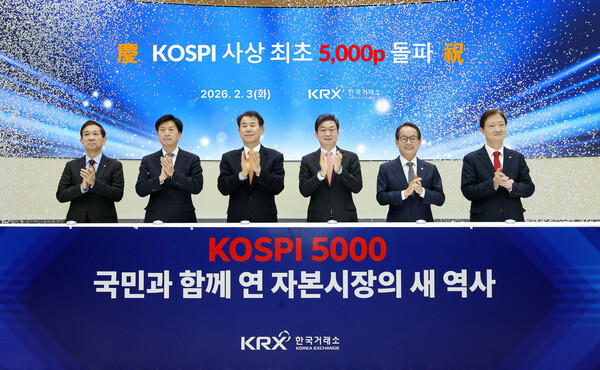
Experts said the KOSPI reaching 5,000 is more than a number and reflects the process of advancing Korea’s capital market.
The Korea Exchange on Feb. 3 held the 'KOSPI 5,000 and Beyond' seminar in Yeouido, Seoul. The seminar discussed conditions for settling into a KOSPI 5,000 era and for further gains, as well as the impact of a stock market rise on the Korean economy.
Cho Soo-hong (조수홍), head of research at NH Investment & Securities, analysed the KOSPI’s current situation as the result of global liquidity expansion aligning with semiconductor-led profit growth and policies to normalise the capital market.
He stressed that 3 conditions are needed to settle into the 5,000 era: sustained momentum in corporate profit growth, continuity in changes to the capital market’s structure, and maintaining confidence in U.S. asset markets.
Cho in particular pointed out that growth momentum in the semiconductor industry is most important.
He said that considering the irreversibility of investment in artificial intelligence and the diversification of automotive applications, earnings visibility could be secured after 2026. He also assessed last year’s revision of the Commercial Act to expand directors’ duty of loyalty, the separate taxation of dividend income and the institutionalisation of share buyback cancellations as symbolic changes toward capital market normalisation.
He also noted that the size of the ETF market has grown nearly twofold from a year earlier.
He said bank deposits are flowing into the stock market in the form of ETFs, and that retirement pensions are accelerating a shift from principal-protected products to return-seeking products. He added that concerns about falling potential growth from ageing can be overcome through productivity improvements by applying AI.
Kim Hak-kyun (김학균), head of research at Shinyoung Securities, gave a presentation on how a rise in stock prices contributes to the Korean economy. He analysed the KOSPI’s 75 percent rise despite last year’s GDP growth of only 1 percent as global liquidity acting more favourably on asset markets than on the real economy.
He pointed to a lack of shareholder returns by semiconductor companies as a reason the Korean market is still undervalued.
He said Samsung Electronics, for example, earned 421 trillion won over the past 15 years, but 30 percent of net profit goes to capital investment while dividends amount to only 19 percent. He said Apple invests only 16 percent of net profit in facilities and returns the rest to shareholders.
Kim also pointed to positive signals. He cited an increase in the number of shareholders who directly benefit from rising stock prices. He said Samsung Electronics alone has more than 5 million shareholders.
He also mentioned structural problems in the KOSDAQ market. He said the index is at one-third of its all-time high, but market capitalisation has hit a record, which suggests distorted indicators due to an increase in newly listed firms.
He said 17,000 stocks are currently listed and that many zombie firms remain, leaving the market with a distorted structure.
In response to these suggestions, Ko Young-ho (고영호), director of the Capital Markets Division at the Financial Services Commission, set out the government’s strong intention to improve the market’s structure.
The government plans to expand and reorganise a joint response team involving the Financial Services Commission, the Financial Supervisory Service and the Korea Exchange to root out stock manipulation in order to establish market fairness.
Ko said, "What stock manipulation forces fear most is an internal whistleblower." He said the government is pushing a plan to confiscate illicit gains from unfair trading and sharply increase rewards using those funds.
The government will also strengthen market self-correction by forcing zombie firms out.
Ko said the reason the KOSDAQ market’s capitalisation increased fivefold while the index stood still is a structure in which there is only entry through listings and no exit. He said the government will shorten the delisting review period from up to 2 years to 1.5 years and set up a dedicated review team within the exchange to swiftly screen out weak firms.
The government will also speed up work on institutional measures to protect ordinary shareholders.
Ko said the government is discussing with the National Assembly plans to introduce a mandatory tender offer system so that ordinary shareholders can share control premiums in mergers and acquisitions, and to require fair value assessments when calculating merger values. He said the government will also persist in pushing measures including mandatory cancellation of treasury shares and expanding directors’ duty of loyalty through revisions to the Commercial Act to resolve the Korea discount.
 Sang-yeop Oh
yub@d-today.co.kr
Sang-yeop Oh
yub@d-today.co.kr