
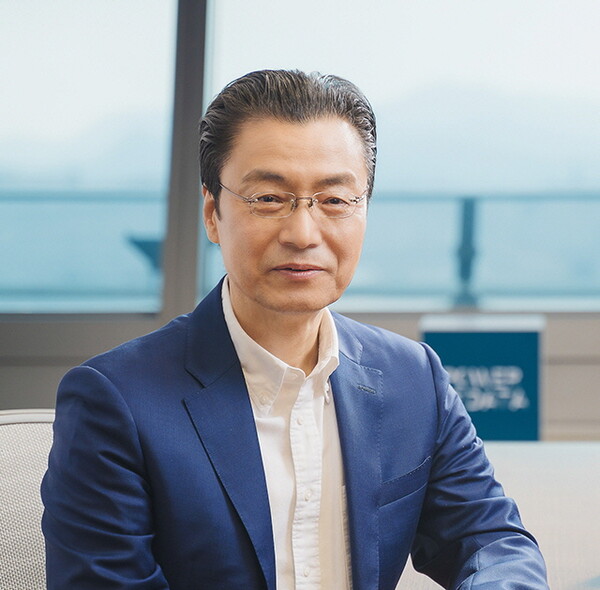
[Seung-cheol Choi (최승철), head of Cloudera Korea] The day you go to the office and the colleague at the next desk is no longer a person, but not a typical robot either, and is instead an 'AI agent', may not be a distant-future story.
An AI agent trained on vast amounts of data has decision-making capabilities and can be used at scale across many tasks. It monitors global supply chains, processes hospital medical records, writes new rules and even produces the news we read this morning. This is not a movie plot. AI agents are a major shift that is becoming reality and is fundamentally changing the way work is done.
In the era of AI agents, the question we must ask is, "Where is the data, and who controls it, who manages it and who uses it?" This is not a technical issue. It is an issue of power and independence. If you cannot store, trust and manage your data on your own, and cannot verify what an AI agent has learned and who it is communicating with, you cannot say you have AI leadership. To adapt and grow in the new era, a platform with four characteristics must be adopted.
1. Open data: track data movement with data lineage, provenance and verifiable governance 2. Open source software: stronger security and robust data control 3. Open standards: agent cooperation and cross-department interaction through shared protocols 4. Open skills: broad understanding of capabilities to interpret and verify AI decisions
AI agents can read, analyse and reason with data, but what action they take depends entirely on what 'capabilities' they have. These capabilities can be learned, accumulated and shared. An AI agent recently launched by a company goes beyond a simple chatbot. It can read and write files directly on a user’s PC and can plan and execute multi-step tasks on its own. Many companies, not only finance and legal teams, are expected to run this at scale. Using it, however, can raise the risks around governance and control of data assets. What truly matters is where and how the model is trained and managed, and how its decisions will be controlled and checked.
'Sovereign AI and private AI platforms' can be the answer. As an HR team manages employees, such a platform must verify AI agents’ identities, manage them to operate in line with an organisation’s values and standards, monitor performance and support collaboration across systems. This must be backed by a technical foundation. A hybrid AI environment with security that aligns with country-specific regulations, open-source data pipelines, a governance-centred orchestration layer and modular LLM serving infrastructure are at the core.
Digital identity and agent oversight must also be open and transparent. For this, openness and governance must be secured in code, data and protocols. Digital IDs that authenticate not only humans but also agents and their actions, knowledge graphs that share organisational knowledge across systems, and audit trails that record every decision, inference and prompt must be built.
None of this will be easy. Bold decision-making, sustained investment, cross-department cooperation and technology leadership rooted in values are needed. If the aim is to create genuine innovation and value through AI agents rather than short-term targets, AI agents should be treated not as a simple framework but as fellow members of a digital society built on governance and trust.
 Seung-cheol Choi
delight@d-today.co.kr
Seung-cheol Choi
delight@d-today.co.kr