
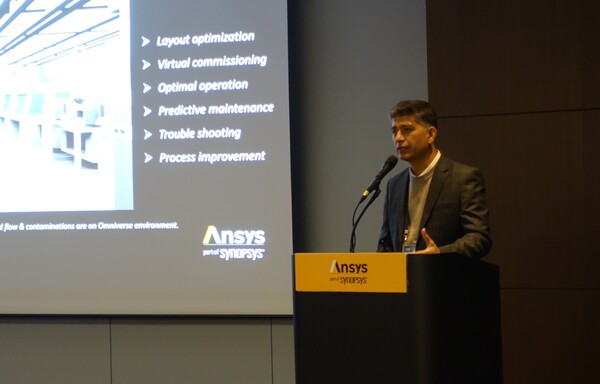
Ansys Korea, a global engineering simulation company, held an "Industry-Tailored Simulation AI Solution Seminar" on Jan. 22 at COEX in Samseong-dong, Seoul, to share strategies for applying AI based on engineering simulation.
The seminar featured six presentation sessions, including opening remarks by Padmesh Mandloi (패드메쉬 맨들로이), Asia vice president for customer support at Ansys, under the theme "Engineering simulation innovated by AI" and ways to apply simulation-based AI required at industrial sites.
In the first presentation, Ansys Korea managing director Tae-shin Kang (강태신) introduced an end-to-end simulation platform-based approach spanning the entire process from product design to manufacturing, alongside key challenges facing the manufacturing industry in the era of digital transformation, under the theme "A digital manufacturing ecosystem created by Ansys."
Ansys Korea professional Minwook Lee (이민욱) shared workflows for design understanding, model calibration, optimisation and robustness evaluation using Ansys optiSLang MOP (Meta-model of Optimal Prognosis) and FMOP (Field MOP). He also addressed applicability from the perspective of the latest simulation-based AI workflows, along with methodologies to improve design process efficiency.
Ansys Korea professional Tae-jin Kim (김태진) introduced a data-mining automation methodology based on PyAnsys and an automated process for building meta-models using Ansys optiSLang. He specifically explained the role simulation can play in generating and preprocessing training data and in labelling for AI implementation. Young-taek Lim (임영택), CEO of Onstream, presented ways to build physics-based AI models by generating virtual training data through simulation and fusing it with real data.
Ansys Korea professional Kyung-mo Yang (양경모) introduced key elements and application scenarios for implementing predictive models and digital twins under the theme "First step in AI-based predictive design: Near real-time digital twins completed with reduced-order models (ROM) and Hybrid Analytics."
Finally, Ansys Korea manager Jeong-won Lee (이정원) presented a case of building a machine-learning haemodynamics prediction model based on 4D Flow MRI data using Ansys SimAI and shared an application case combining medical imaging data with simulation-based analysis.
Mandloi, Asia vice president for customer support at Ansys, said, "This seminar shared practical direction on how the combination of simulation and AI is applied at industrial sites and what engineering organisations need to prepare." He added, "Ansys Korea will continue to expand technology and ecosystem support so customers can accelerate full lifecycle innovation from design to operations."
 Chi-gyu Hwang
delight@d-today.co.kr
Chi-gyu Hwang
delight@d-today.co.kr