
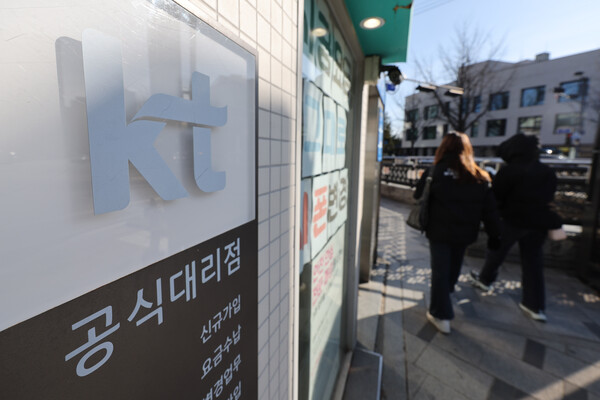
With KT ending a penalty fee waiver introduced after unauthorized small-payment incidents, attention is focused on how the telecom industry's balance of power may shift.
Over two weeks, the number of subscribers leaving KT exceeded 310,000, about double the scale of defections seen during last year's SK Telecom USIM hacking incident.
The telecom industry said 312,902 subscribers left KT during the period when the waiver applied from Dec. 31 last year to Jan. 13. That is about double the number of defections, 166,000, during SKT's waiver period last year.
During the two weeks KT implemented the waiver, total number-porting transactions are estimated at about 660,000, or about 47,000 a day on average. That is about three times the daily average of about 15,000 when there are no special factors such as a flagship launch. The three mobile carriers' rollout of large subsidy policies as they competed to attract subscribers is also seen as having spurred demand for switching.
◆ 64.4 percent moved to SKT... restoration program hits the mark
The biggest beneficiary is SKT. Of the 312,902 subscribers who left KT, 64.4 percent, or 201,562, moved to SKT. Those who moved to LG Uplus accounted for 22.4 percent, or 70,130, while 13.2 percent, or 41,210, moved to budget carriers (MVNOs).
An analysis says SKT drew in many of them because its membership restoration program proved effective. SKT restores tenure and membership grade as they were if customers who terminated SKT lines between April 19 and July 14 last year rejoin within 36 months.
That effectively created a structure in which customers who moved from SKT to KT during the USIM hacking incident could return to SKT without losses through KT's penalty fee waiver. An industry official analysed that customers who first moved from SKT to KT had a strong incentive to return because they could restore previous benefits such as family-plan discounts.
LG Uplus also enjoyed a certain level of spillover benefit. It is under investigation over allegations including concealing a breach incident, but an analysis says critical public opinion concentrated on KT, making LG Uplus' missteps stand out less.
◆ 전망도... new CEO faces test as Q1 wireless revenue seen down 50 billion won
KT posted a net decline of 179,760 subscribers even after reflecting newly incoming customers. Including budget carriers, the drop was 238,062. In brokerage circles, the decline in KT's wireless revenue in the first quarter due to the subscriber outflow is estimated in the range of 50 billion won. The outflow could also be negative for average revenue per user (ARPU) and the stickiness of bundled products.
This situation is also expected to be no easy task for KT's new leadership set to launch soon. Earlier, KT named former head of its enterprise division Yoon-young Park as its next chief executive. Park, who is to be appointed after a regular shareholders meeting in March, faces the tasks of weakening profitability and restoring customer trust at the same time.
KT will accept applications for termination penalty fee refunds until the 31st. The industry expects the number of those eligible for refunds could reach 660,000.
SK Telecom increased subscribers by enjoying the biggest spillover effect from KT's waiver. Still, it is not expected to be easy for SK Telecom to immediately regain the 40 percent market share it lost in the wake of last year's USIM hacking incident.
According to the Ministry of Science and ICT's "Wired and Wireless Telecom Service Subscriber Status and Wireless Traffic Statistics", SKT's market share stood at about 38.9 percent as of October last year. Even after adding about 160,000 net new subscribers during the KT outflow phase, it remains in the 39 percent range.
After the waiver ended, the number-porting market appears to have paused for breath. Signs of stabilisation are also being detected, such as a reduced scale of paybacks at major distribution channels in the Seoul area.
Some see Samsung Electronics' flagship Galaxy S26 launch scheduled for March as a turning point. An analysis says that with SKT holding market leadership, the impact of the new handset launch could lift its market share to 40 percent. An industry official said it may be difficult for SKT to immediately regain 40 percent market share, but leadership in the number-porting market has already shifted to SKT, adding that Galaxy S26 marketing competition will determine the telecom market's configuration in the first quarter.
 Jinho Lee
jhlee26@d-today.co.kr
Jinho Lee
jhlee26@d-today.co.kr