
[Digital Today reporter Oh Sang-yup] South Korean stocks are expected to test whether they can regain the 5,000 level this week. Foreign inflows returned last week, helping drive a sharp rebound, but concerns remain over artificial intelligence (AI) investment costs and high interest rates. Nvidia CEO Jensen Huang's appearance before the U.S. Congress and employment data are expected to determine whether the rebound can continue.
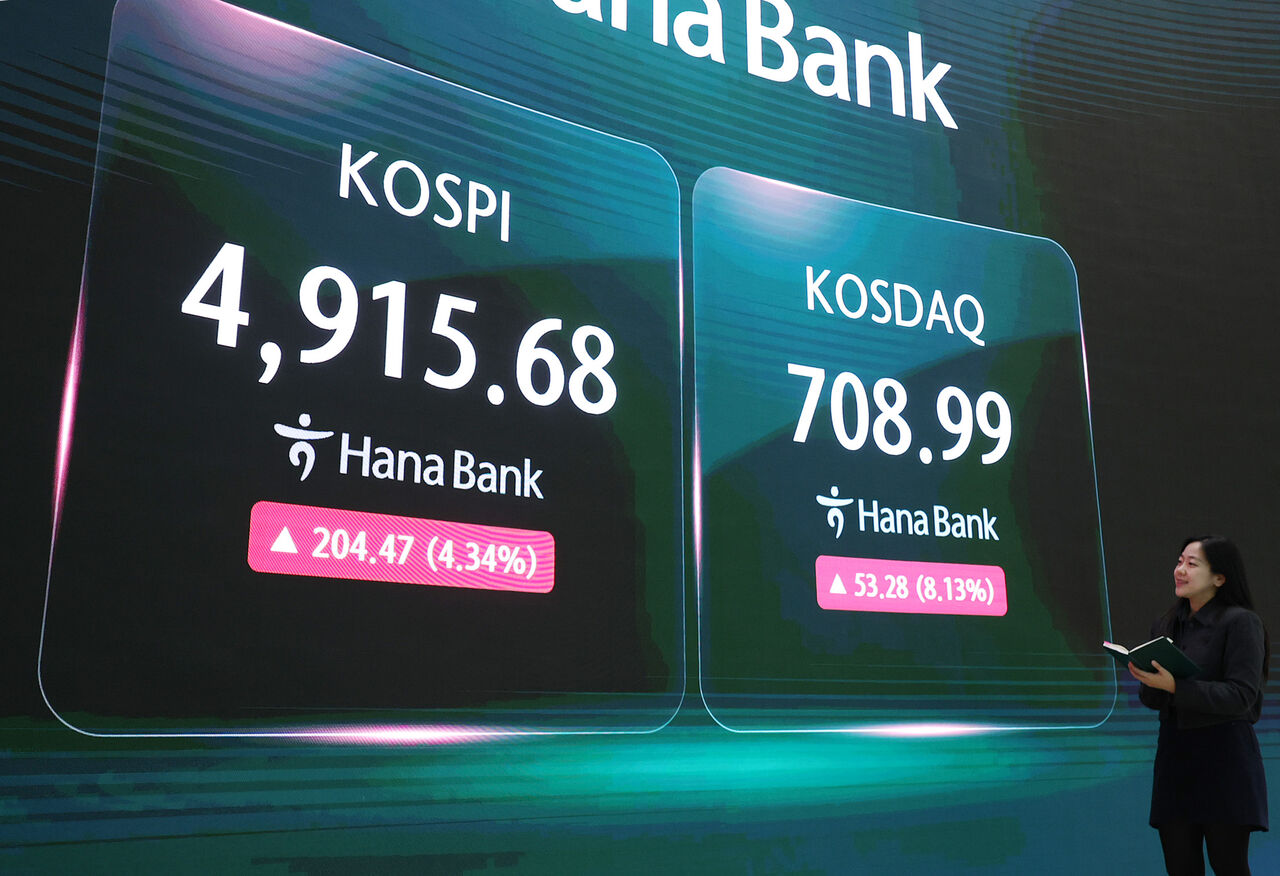
The KOSPI closed at 4,915.68 on Nov. 27, up 204.47 points, or 4.34 percent, from the previous session. The Kosdaq also jumped 8.13 percent to 708.99. Foreigners bought more than 1 trillion won net on the KOSPI, breaking out of a selling trend that had persisted during the recent sharp drop.
Still, last week's moves alone make it hard to call it a trend reversal. After surging 6.32 percent on Nov. 24, the KOSPI fell 6.16 percent the next day, swinging sharply day to day. It rebounded strongly again on Nov. 27, but remains below 5,000.
U.S. stocks rose in the latest session, led by AI-related shares. On Nov. 27, the S&P 500 index closed up 1.6 percent at 7,297.49, the Nasdaq index rose 2.3 percent to 24,129.50 and the Dow Jones index gained 1.2 percent to 50,774.94.
For the week, the S&P 500 rose 5.6 percent and the Nasdaq climbed 6.7 percent, with investor sentiment partly recovering after the sharp selloff.
Industry officials see stocks moving more sensitively to AI investment costs and interest rates than to corporate earnings recently. Demand for AI servers and memory remains solid, but doubts have not been resolved over how companies will raise the massive funds needed to build data centres and turn them into actual profits.
The U.S. personal consumption expenditures (PCE) price index for October, released recently, also showed that burden. The PCE price index rose 3.8 percent year on year and core PCE increased 3.3 percent. The U.S. 10-year Treasury yield also rose back into the 4.9 percent range on Nov. 27, nearing 5 percent. If inflation and rates stay elevated at the same time, funding burdens for AI companies and valuation pressure on growth stocks could both increase.
The market's first focus this week is Huang's appearance before the U.S. Congress. Huang is set to hold closed-door interviews on Dec. 1 with 3 committees, including the U.S. House foreign affairs, intelligence and China committees, and to appear at a public hearing of the Senate Banking Committee on Dec. 3.
The public hearing will focus on U.S. AI competitiveness and export controls. Discussion is expected to include how to block China's access to advanced AI semiconductors and the effectiveness of U.S. semiconductor export restrictions on China. If related regulations are strengthened, uncertainty could rise again not only for Nvidia but across the global semiconductor supply chain.
If problems with existing regulations are整理 and the policy direction becomes clearer, it could help reduce the uncertainty that has weighed on semiconductor shares recently.
In South Korea, Samsung Electronics and SK Hynix account for a large share of the KOSPI's market capitalisation. Policy changes surrounding Nvidia are therefore likely to have a direct impact on the index.
Investors will also need to keep checking companies' AI investment plans. AI and cloud-related events will continue this week, including AWS re:Invent. The market is expected to focus less on new AI services themselves than on how much data centre investment costs are being reduced and how much returns on investment are improving.
A key issue in the AI market is shifting from whether investment will expand to how efficient that investment is. Even if major tech companies' revenue and AI demand increase, cash flow comes under pressure if investment costs rise faster.
Conversely, if revenue and profitability are confirmed from existing data centre investment, concerns about an AI investment bubble that have grown recently could ease significantly.
Economic indicators are also in focus this week. On Dec. 1, the U.S. ISM manufacturing purchasing managers' index (PMI) and the Job Openings and Labor Turnover Survey (JOLTS) will be released. On Dec. 2, ADP private employment data is due, followed by the ISM services index on Dec. 3. The U.S. jobs report for November will be released on Dec. 4.
The jobs report is a key indicator ahead of the U.S. Federal Open Market Committee meeting on Dec. 8 to 9. If employment and wages are stronger than expected, the likelihood of additional policy rate hikes could increase, pushing U.S. Treasury yields back above 5 percent.
If employment slows moderately, rate pressure would ease and could have a positive impact on technology shares that have fallen sharply and on South Korean semiconductors.
In South Korea, November export data due on Dec. 1 will be a gauge for semiconductor conditions. Exports in Nov. 1 to 20 showed a strong trend led by semiconductors. If monthly exports also confirm that semiconductor demand is being maintained, it could support profit forecasts for Samsung Electronics and SK Hynix next year.
Foreign flows also matter. The recent sharp drop in the KOSPI was driven more by foreigners' large-scale selling of cash equities and futures than by downward revisions to corporate profit forecasts. Foreigners were net buyers of more than 1 trillion won on the KOSPI again on Nov. 27. If buying continues this week, it could help the index regain 5,000.
Industry officials say it is hard to conclude that flows have turned based on one or two days of net foreign buying. Market volatility remains high, and U.S. long-term yields and AI-related credit risks have not been fully resolved.
On valuation, there is an assessment that much of the price decline has already played out. The KOSPI recently entered a historically undervalued range as share prices fell much faster than corporate profit forecasts. Samsung Electronics and SK Hynix have also seen their share-price declines from their peaks far exceed the scale of revisions to profit forecasts.
This week, the focus is expected to be on whether the index can raise its lows rather than surge sharply in one move. If the index regains 5,000, foreign buying continues and advances broaden beyond semiconductors, it could be seen as a signal that the sharp selloff that has continued since last month has passed its bottom.
If U.S. employment comes in strong and long-term yields jump again, or if Huang's congressional appearance heightens concerns over semiconductor restrictions on China, volatility could expand again.
Ultimately, the key question this week is whether 3 variables can improve at the same time: AI investment sentiment, interest rates and foreign flows. If U.S. employment reduces rate pressure, policy uncertainty related to Nvidia eases and South Korean semiconductor exports continue their strong run, the KOSPI could extend its rebound past 5,000.
Seo Sang-young (서상영), a managing director at Mirae Asset Securities, said various factors such as AI credit risks, earnings, AI conferences and Treasury yields would affect the market this week. He said the market would see wider differentiation between AI-related companies that can cover investment costs with actual revenue and cash flow and those with high reliance on borrowing.
Noh Dong-gil (노동길), a research fellow at Shinhan Investment Corp, said volatility would remain significant in November, but investors need to check leading shares and individual companies' earnings, centred on semiconductors. He said foreign flows and stable interest rates are important for a trend recovery.
Lee Jae-man (이재만), an analyst at Hana Securities, said stock prices already reflect fairly extreme scenarios. He said a fall in market rates or confirmation of restored confidence in earnings forecasts could become momentum for an index rebound.
Lee Kyung-min (이경민), an analyst at Daishin Securities, said whether uncertainty surrounding Huang eases and U.S. jobs data are key variables that will determine AI investment sentiment and the possibility of additional tightening. He said a selective approach focused on semiconductors and IT hardware that are undervalued relative to earnings is valid.
 Oh Sang-yup
yub@d-today.co.kr
Keyword
#KOSPI #Nvidia #Jensen Huang #Samsung Electronics #SK Hynix
