
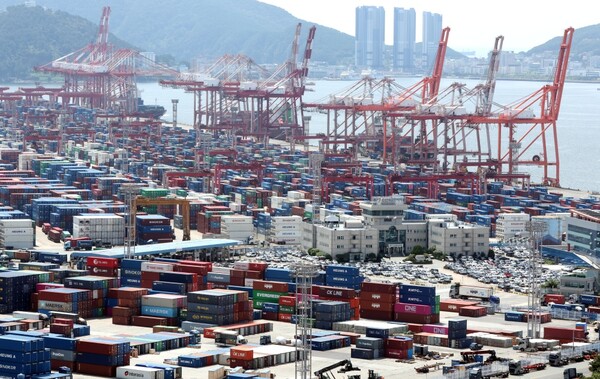
The United States has proposed a 15 percent tariff on South Korea, citing overcapacity, in line with last year’s trade agreement. The Office of the U.S. Trade Representative (USTR) judged that the South Korean government supports manufacturing through policy finance and sector-by-sector plans in ways that undermine U.S. commerce, but set the rate by also considering existing tariffs and trade agreement terms. It specified that the rate could be raised by a larger margin than Japan and the European Union if consultations and implementation of commitments are insufficient, meaning South Korea must demonstrate implementation until a final decision.
USTR on Tuesday announced the results of a Trade Act Section 301 overcapacity investigation covering 16 economies including South Korea. It launched the probe on March 11, saying overcapacity driven by subsidies and other support created an environment that disadvantages U.S. companies, and issued the findings about 8 months later. It first proposed baseline rates for 14 economies by comprehensively considering existing tariff levels, bilateral consultation results, trade agreement terms and trade balances.
USTR said it saw the South Korean government as having maintained and expanded manufacturing by drawing up industry and sector plans and providing preferential loans through policy finance institutions. In a Federal Register notice, it cited as evidence of overcapacity that South Korea’s goods trade balance with the United States swung from a $10 billion deficit in 2023 to a $52 billion surplus in 2024. It also pointed to imports from non-market economies and foreign direct investment (FDI), saying South Korea does not properly respond to global overcapacity.
It cited automobiles, semiconductors and petrochemicals as sectors where harm is pronounced. A March Federal Register notice broadly mentioned exports of electronic equipment, automobiles, machinery, steel and ships as a backdrop to the surplus, but this time it separately identified industries affected by industrial policy. The South Korean government has countered in a written submission on April 15 and at a public hearing on May 5 to 8 that South Korean manufacturing is closely linked to U.S. supply chains and does not qualify as an overcapacity country. It has also confirmed at each high-level contact the U.S. side’s intent to respect the South Korea-U.S. tariff agreement.
Still, South Korea’s baseline rate remained within the scope of the South Korea-U.S. trade agreement. According to the Ministry of Trade, Industry and Energy, South Korea, Japan, the EU, Taiwan and Switzerland would face a total 15 percent rate by adding most-favoured-nation (MFN) tariffs and existing Section 301 tariffs. South Korea last year promised $350 billion in investment in the United States and agreed to cut reciprocal tariffs to 15 percent from 25 percent. A forced labour tariff of 12.5 percent finalised in July is also included in the combined calculation. When the forced labour tariff was finalised, the remaining room up to 15 percent was 2.5 percentage points, and the overcapacity tariff is interpreted as being levied within that headroom. China was proposed a 20 percent rate. For items that faced tariffs of about 25 percent during the first Trump administration, this new 20 percent is added on top.
The United States said it would follow the agreement in the final rate as well. The ministry said it conducted advance consultations with USTR ahead of the announcement and that the U.S. side reaffirmed its intention that these are proposed rates and that it would respect the outcome of the South Korea-U.S. tariff agreement at the time of a final decision.
USTR also presented higher rates to apply when consultation results or implementation of commitments are not satisfactory. South Korea and Taiwan would be 25 percent, Japan and the EU 20 percent, and China 40 percent. Compared with Japan and the EU, which share the same 15 percent baseline, South Korea’s increase is 5 percentage points larger. South Korea’s higher rate matches the reciprocal tariff level before last year’s agreement, meaning if this path is applied, the tariff-cut effect gained through the investment pledge disappears.
The final rate is expected to be set after receiving written comments until Jan. 5 next year and holding a public hearing on Jan. 25. The tariff is an alternative measure the Trump administration produced after the Supreme Court ruled in February that reciprocal tariffs based on the International Emergency Economic Powers Act (IEEPA) were illegal. The cited legal basis, Trade Act Section 301, gives the president broad discretion over investigations and measures.
Earlier, the forced labour tariff was finalised in July at 12.5 percent, unchanged from the level announced in June, despite the government and the Korea International Trade Association asking for it to be lowered to 10 percent. The ministry said it would respond to follow-up procedures such as submitting written comments together with relevant ministries and industry, while implementing follow-up items under the South Korea-U.S. tariff agreement to maintain a balance of interests. Since the United States will judge whether consultations and implementation are satisfactory, South Korea, which faces a larger possible increase, still has investment implementation speed as a rate variable until the final decision.
 Seok Dae-geon
d2dg@d-today.co.kr
Keyword
#USTR #Trade Act Section 301 #Ministry of Trade #Industry and Energy #MFN #IEEPA
