
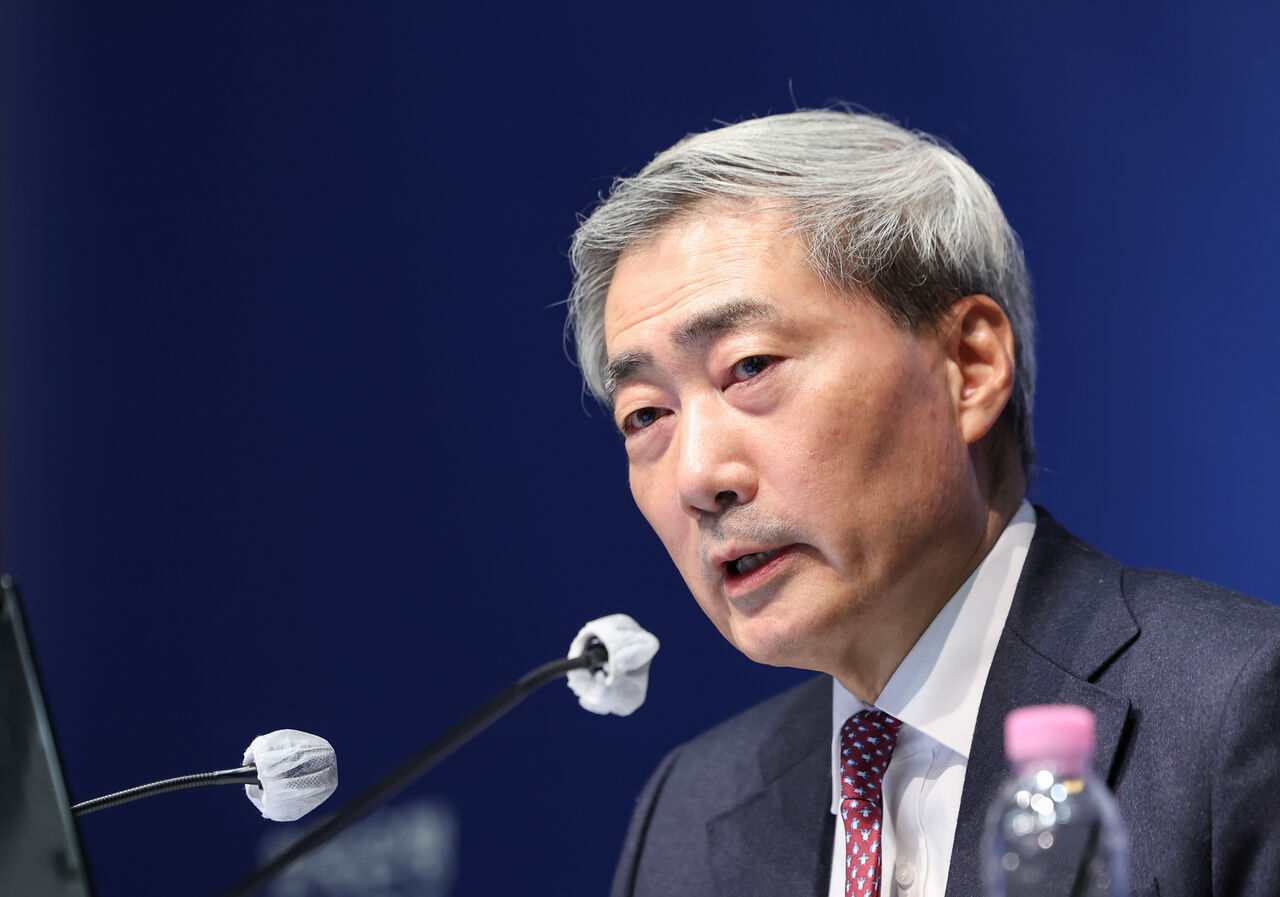
The Bank of Korea raised its policy rate to 3.25 percent after sharply raising its economic growth forecasts for this year and next on the back of a semiconductor boom. But it cut its forecast for private consumption growth this year. The economy is growing rapidly on exports and corporate earnings, but the benefits have not spread sufficiently to households. Borrowers’ financial cost burdens are expected to rise further as rates increase.
On Nov. 26, the Bank of Korea's Monetary Policy Board held a policy-setting meeting and raised the policy rate by 0.25 percentage points to 3.25 percent from 3.00 percent. It was the third hike this year, following moves in July and August.
The central bank raised its growth forecast for this year to 3.9 percent from 3.3 percent and lifted next year’s forecast to 4.1 percent from 2.9 percent. It said exports and investment would continue to post strong growth as the semiconductor cycle stays strong on the expansion of AI infrastructure.
By contrast, it lowered its forecast for private consumption growth this year to 1.8 percent from 2.1 percent. It said a sharp stock market correction in the second half had a negative effect on household consumption.
Semiconductor firms' operating profit seen nearing 700 trillion won; domestic spillovers still limited
The divergence between the growth and private consumption forecasts reflects a growth structure concentrated in the semiconductor industry.
At a news conference, Bank of Korea Governor Hyun Shin (신현송) said nominal gross domestic product was about 2,600 trillion won last year and is expected to rise well above 3,000 trillion won this year.
He estimated that while the shares of household wages and corporate operating profit had previously been about 50 to 50, this year the balance would shift to around 40 to 60, with more weight on corporate operating profit. He forecast that semiconductor companies’ operating profit would come close to 700 trillion won this year.
The central bank also said at an economic outlook briefing later in the day that the nominal share of IT manufacturing expanded to more than 20 percent this year from 9 percent last year. It said the semiconductor-led growth has still had limited spillover to other industries, and the employment spillover effect of the semiconductor sector is relatively low. That could lead to a gap between growth and how the economy is felt by the public.
Shin said profits earned by semiconductor firms would be returned to the national economy through corporate tax, performance bonuses, dividends and investment, but there would be a time lag before that leads to rising household income and a recovery in private consumption.
The central bank forecast private consumption growth would rise to 2.4 percent next year as such spillover effects expand. That would still be low compared with its 4.1 percent growth forecast for next year.
Corporate liquidity is ample; financial burden on vulnerable borrowers seen rising
The problem is that financial cost burdens from monetary tightening could rise before the domestic spillover effects of the semiconductor boom take hold in earnest.
The central bank assessed domestic liquidity conditions as quite favorable as semiconductor firms manage remaining funds in short-term money markets after paying taxes, dividends and performance bonuses.
But ample liquidity across the broader financial market does not directly translate into improved repayment capacity for vulnerable borrowers, such as low-income households and self-employed people. Higher lending rates following the policy rate hike can increase their interest burdens. It could also weigh on financial institutions’ delinquency rates and soundness management.
On the issue, Shin said, "Because monetary policy spreads across the entire market, there are limits to implementing policy selectively." He said, "For vulnerable groups, fiscal policy and financial policy accompanied by fiscal resources are appropriate." He added that using debt restructuring as needed would also be appropriate.
There is also a chance the financial cost burden for vulnerable borrowers could be prolonged. That is because the central bank has left open the possibility of additional tightening even after this hike. Conditional forecasts for the policy rate in six months, released that day, showed dots distributed at 3.25 percent for 6 members, 3.50 percent for 8 members and 3.75 percent for 7 members.
Since the central bank is projecting 2028 as the time when consumer inflation converges to its target level, the tightening stance could continue for some time.
That could prolong the burden of high interest rates before the benefits of the semiconductor boom spread sufficiently to households. The financial sector also faces the task of managing expanding repayment burdens among vulnerable borrowers and potential risks of bad loans.
Park Jun-woo (박준우), an analyst at Hana Securities, also wrote in a report that how much income gains from an export boom spread into household consumption would be a key variable determining the pace of future rate hikes.
Park said, "If the policy rate rises above 3.50 percent, the risk of overtightening could increase." He said he expects a hold after an additional hike in February next year.
 Ji-young Lee
ljy@d-today.co.kr
Keyword
#Bank of Korea #Monetary Policy Board #semiconductors #GDP #Hana Securities
