
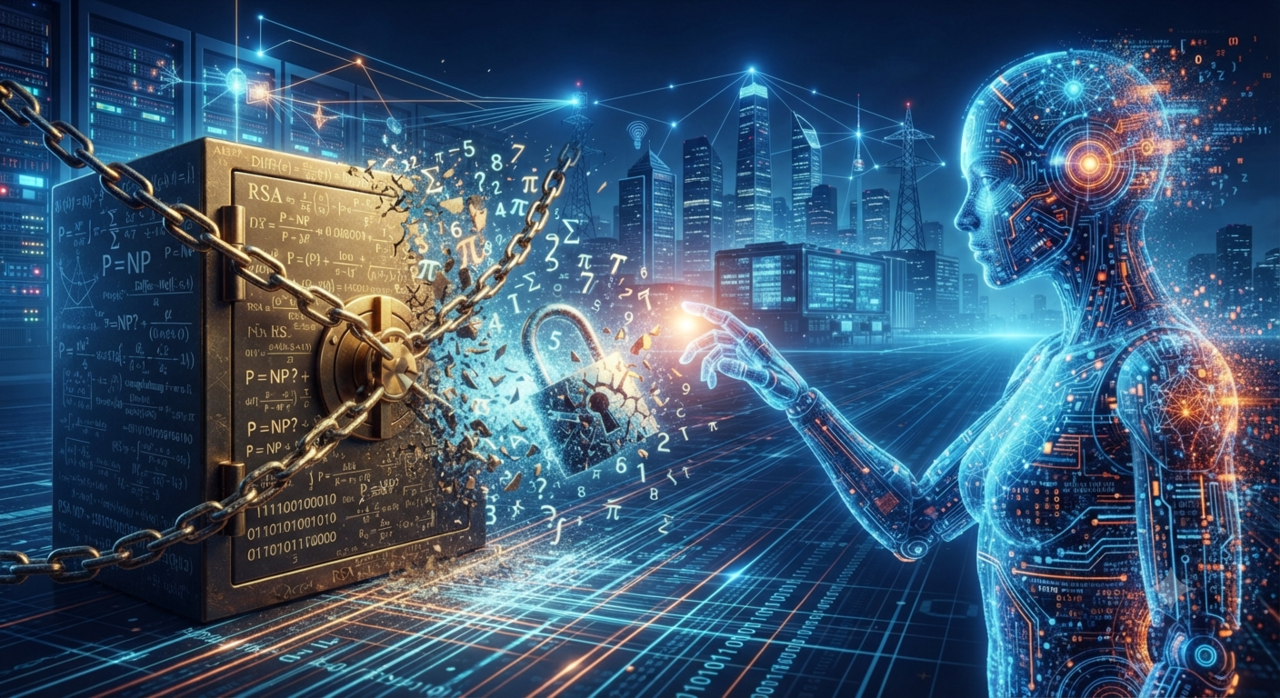
As AI continues to solve difficult mathematics problems, concerns appear to be growing that encryption systems that have played a key role in finance and national security could be shaken.
A mathematician at Anthropic recently said that, with help from Claude, the person proved the Riemann hypothesis, which had remained unsolved for 167 years since 1859. OpenAI and Anthropic each proved, in a competitive manner, problems close to "P versus NP," one of the biggest challenges in computer science.
The Riemann hypothesis deals with how prime numbers are distributed according to certain rules. "P versus NP" asks whether problems that are easy to verify are also easy to solve.
Why, then, do AI achievements in mathematics spread into worries that encryption systems could be shaken?
News that AI proved the Riemann hypothesis led to concerns about undermining encryption systems because RSA, the most widely used encryption method today, also depends on prime numbers.
RSA is based on the fact that while it is easy to multiply two large prime numbers, it is very difficult to split the product back into the original primes through factorisation. Proving the Riemann hypothesis does not immediately break encryption, but the essence of the current concern is that a deeper understanding of primes could reveal a way to speed up factorisation. Marcus du Sautoy (마커스 듀 소토이), a professor at Oxford University, said, "Any insight into prime numbers could reveal something new about factorisation."
The P (Polynomial time) versus NP (Nondeterministic Polynomial time) problem is the same. The asymmetry between P and NP is at the core of modern encryption systems, and if it were proven that P and NP are the same, almost all encryption could theoretically be broken.
There is also talk that AI companies have already secured bigger achievements. According to the Financial Times (FT), theoretical computer scientist Scott Aaronson (스콧 애런슨) said on his blog, "Based on several reliable sources, I am essentially sure that AI R&D companies are holding more than one bomb in cryptography-related mathematics."
Emmanuel Thome (에마뉘엘 토메), a researcher at France's national research institute Inria, also said, "The reason it looks like there are few cases of AI changing cryptography is simply that companies do not disclose all results." Concern is also being fuelled by the lack of proper preparedness for scenarios in which AI shakes encryption systems.
Technologies seen as threatening encryption systems have so far been quantum computers, which remain far from mass adoption, rather than AI. As a result, preparation for quantum computers was thought likely to proceed in a relatively orderly manner, but rapid AI advances are upending that calculation, the FT reported. Du Sautoy said the issue is more urgent because, unlike quantum computers, AI can crack encryption without new machines.
If encryption systems are shaken, the impact will not stop at data leaks. Digital signatures used to authenticate transactions, identity and software could also collapse under forgery.
According to the FT, the Bank of England warned in a recent report that if encryption collapses, trust in financial contracts, transactions and long-term stored records could be damaged. It also raised the so-called "harvest now, decrypt later" risk of collecting encrypted data now and decoding it later.
Asked whether AI models are at a level where they can break encryption, Bank of England Governor Andrew Bailey said, "As the AI companies say, we are in the exponential part of the development curve." He also urged international cooperation to verify models before and after release, saying companies are cautious about disclosing their latest models.
Some also say it is too early to view it as an immediate threat. No instance of AI breaking widely used encryption has yet been made public.
Many computer scientists still see finding an answer to P versus NP as far harder than verifying one. Nicky Mouha (니키 무하), founder of Keycryptic and a former cryptographer at the U.S. National Institute of Standards and Technology (NIST), said that even if P=NP is proven, it would only mean it can theoretically be broken and would not mean it is actually broken. Even so, Axios reported that AI could find a shortcut to quickly solve specific encryption.
Even if it is at the level of a scenario for now, there is a need to prepare in advance for a situation in which AI disables encryption systems, but there appears to be no clear answer yet.
According to the FT, lattice-based cryptography, which is drawing attention as preparation for quantum computers, uses the difficulty of finding a specific point in a multi-dimensional lattice, but whether it will work against AI is also a subject of debate among experts.
Hash-based cryptography, which makes it hard to recover original data by repeating simple calculations countless times, is also an alternative, but there are criticisms that it still lacks heft.
Eli Ben-Sasson (엘리 벤사손), co-founder of Israeli blockchain company StarkWare, which uses hash-based cryptography technology, said hash-based cryptography has drawbacks in that it is heavier than current encryption methods and has narrower uses. He wrote on social media platform X (Twitter), "We need the safest and strongest cryptography possible."
Even so, the cryptocurrency industry appears to be moving toward hash-based cryptography. The Ethereum Foundation also plans to adopt hash-based cryptography by 2029. The Block reported that the Ethereum Foundation said AI is a more urgent threat than quantum computers but that does not mean AI breaks cryptographic assumptions, and it also doubled the size of its protocol security team.
 Hwang Chi-gyu
delight@d-today.co.kr
Keyword
#RSA #Riemann hypothesis #P versus NP #Bank of England #Ethereum Foundation
