
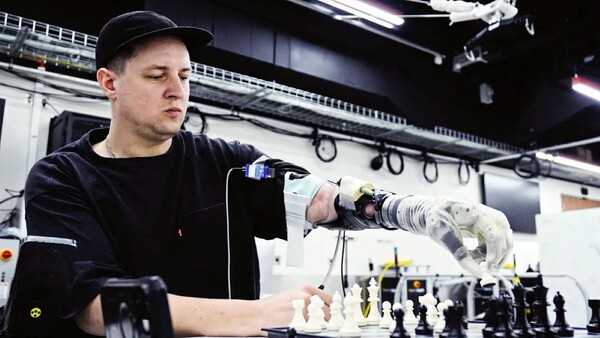
A next-generation bionic prosthetic hand that connects directly to nerves to reproduce hand movement and touch has begun being used in everyday life.
MIT Technology Review reported on Nov. 26 that University of Utah clinical trial participant Avi Davidson (에이비 데이비드슨) became the first case to take an experimental prosthetic that can sense pressure home and use it independently.
The device applies new neural connection technology to the “Luke Arm,” named after Luke Skywalker from the film “Star Wars.” The key lies not in the prosthetic itself but in the interface that connects it to the human nervous system. Through it, a user can move the prosthetic with nerve signals while also receiving sensory feedback on how strongly an object is being gripped. Davidson can now handle fragile items such as grapes and eggs and hold a family member’s hand.
Researchers are checking how useful the technology is in daily life and in what situations it shows limits. They are also observing how long-term use affects Davidson’s psychological stability and his brain and nervous system. He is the ninth participant to receive the implant for the technology and the first to take the prosthetic home for independent use.
Davidson had his left hand amputated after an electrocution accident when he climbed an electric pole at age 16 in 2009. He used several prosthetics afterward, but this device differs in that it connects directly to the nerves in the arm to exchange movement and sensory signals. Jake George (제이크 조지), head of the University of Utah NeuroRobotics Laboratory, explained that pre-surgery physical and psychological assessments and brain tests were used to confirm whether Davidson retained the neural function to move the prosthetic and the brain’s motor representation of his left hand.
In surgery performed in late January, medical staff implanted electrode arrays, each with 100 micro-needles, into three nerves in Davidson’s arm. They also inserted 24 electrodes into muscles around the nerves. Researchers then trained a computer system to convert electrical signals generated in the nerves into movements of the hand, wrist and fingers. The process of recognizing movement took about 5 minutes, but stimulating the electrodes to link them to actual sensation took about 3 days.
Additional adaptation training was also required for real-world use. An occupational therapist in the University of Utah Health system explained that because the method of use differs from existing prosthetics, it is similar to learning a new language. Davidson trained by gripping cooking tools, cutting ingredients and moving plates with the goal of cooking at home. He succeeded in cracking eggs and making an omelet.
Davidson has been using the prosthetic at home since July 10. At first it took him several minutes to write his name, but now it takes only a few seconds. He wears it about 6 days a week, replaces the battery once or twice during the day and removes it at night. It weighs about 5 pounds, or about 2.3 kg.
Unexpected responses have also appeared. Davidson intermittently feels pain from the prosthetic and has also experienced wrist stiffness. Chris Duncan (크리스 덩컨), chief medical officer at BIOS, said it is difficult to explain physiologically because artificial prosthetics have no actual tendons, and raised the possibility that it could be related to the brain’s perception of the hand.
Researchers are preparing a larger follow-up study and are seeking U.S. Food and Drug Administration approval for technology that sends signals bidirectionally with nerves, hoping it will lead to health insurance coverage. They are also reviewing ways to use the technology to operate other devices such as remote controls or wheelchairs.
The clinical trial was designed to run for at least 1 year and is set to end in late January 2027. Whether Davidson can continue to use the prosthetic and implanted devices depends on whether funding can be secured. He said he took part knowing he could not own the devices, and said he wanted to contribute to technological progress rather than seek personal benefit.
 Seung-a Yoo
ysah@d-today.co.kr
Keyword
#MIT Technology Review #University of Utah #Luke Arm #FDA #BIOS
