
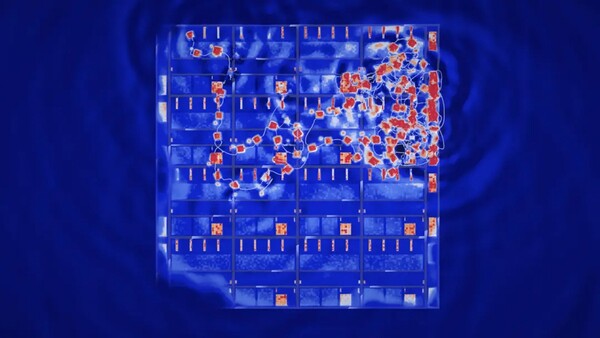
A general-purpose CPU led by AI from initial architecture planning through circuit design and verification recorded 4.59 times the performance per watt of an existing CPU core. It is drawing attention for using AI to develop a new architecture rather than simply optimising existing chip designs.
On Nov. 26 (local time), Japanese media outlet Gigazine reported that U.S. semiconductor design startup Architect Labs on Nov. 18 released design and performance evaluation results for Frostbite, a general-purpose CPU developed using AI agents.
Frostbite is based on the Interaction Nets computing model proposed in 1990. It represents programs as graphs of connected nodes and runs independent computations simultaneously. It aims to improve power efficiency by reducing complex circuits needed to maintain parallel processing and data consistency in conventional CPUs.
Architect Labs used multiple AI agents to analyse existing research papers and benchmarks and to develop data for the architecture, instruction set architecture (ISA), compiler and circuit design. It also established a system to mathematically verify design correctness. In the process, it tested 58 improvements and adopted 37.
The AI also applied a work stealing approach, in which idle processing units take work from adjacent units. When there is no additional work to perform, the unit stops operating to cut power consumption.
The final design, based on a 7-nanometre process, places 16 processing units and runs at an operating frequency of 500 megahertz.
Architect Labs compared a cluster comprising 4 processing units and memory with a conventional in-order single CPU core of similar circuit area. Across 25 tasks, performance per watt posted a geometric mean 4.59 times higher, and performance per unit area averaged 8.77 times higher. In 15 tasks not used for design optimisation, performance per watt was also 3.83 times higher.
The evaluation was based on pre-manufacturing design data rather than an actual chip, and the product name of the CPU used for comparison was not disclosed, requiring additional verification.
Architect Labs plans to build an FPGA-based execution environment and pursue development of a dedicated operating system, along with releasing register-transfer level (RTL) circuit design data and the instruction set.
 Choi Jae-won
ittt_0801@d-today.co.kr
Keyword
#Architect Labs #Frostbite #Interaction Nets #Work Stealing #FPGA
