
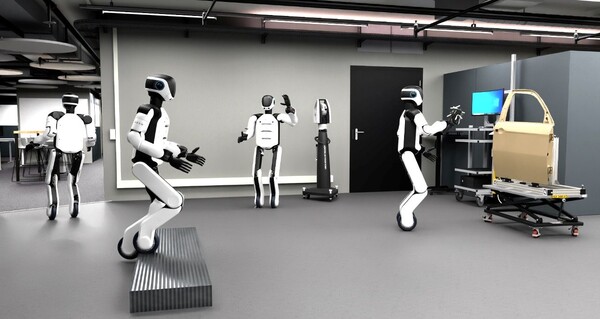
Volvo is pushing a plan to use humanoid robots for repetitive tasks and processes that place heavy physical strain on workers. It has started its first robot training at its Ghent plant in Belgium and plans to deploy the robots to production sites from mid-2027.
On Nov. 26, local time, EV-focused outlet InsideEVs reported that Volvo is bringing in and training Hexagon Robotics' humanoid robot AEON at the Ghent plant. Volvo aims to improve the working environment by using robots for tasks that are repetitive or ergonomically demanding for employees.
Workers are currently teaching the robot to pick up and place parts through imitation learning. Training begins with moving specific parts between two fixed fixtures with high precision, then gradually increases in difficulty to handling multiple parts, moving around production zones and interacting with the plant's automation systems.
Magnus Nilsson (매그너스 닐손), Volvo's chief manufacturing officer, said AEON's humanoid design allows it to work alongside employees while keeping existing production systems and automation equipment in place. The goal is for the robot to take on some of the most physically demanding tasks to improve employees' working conditions, he said.
AEON has a human-like form but moves on wheels instead of feet. It is 1.65 metres tall, weighs 60 kg and has a top speed of 8.6 km per hour. It can lift objects weighing up to 10 kg and uses multiple cameras and sensors to perceive its surroundings and handle parts precisely.
Fixed robotic arms have been used in car plants for decades. More recently, investment has been expanding in artificial intelligence-based robots that can handle tasks in which parts are not placed in the same position each time. Adoption is also growing for so-called pick-and-place tasks, in which parts are picked up, moved and placed in designated locations. Tesla, General Motors, Ford and Rivian are also deploying complex robotic systems in their factories.
Volvo plans to roll out AEON, which is currently in training, step by step in real production environments from mid-2027. In the early stages, it will work alongside people and take on repetitive processes that impose heavy physical strain.
 Yoo Seung-a
ysah@d-today.co.kr
Keyword
#Volvo #Hexagon Robotics #AEON #Ghent #Magnus Nilsson
