
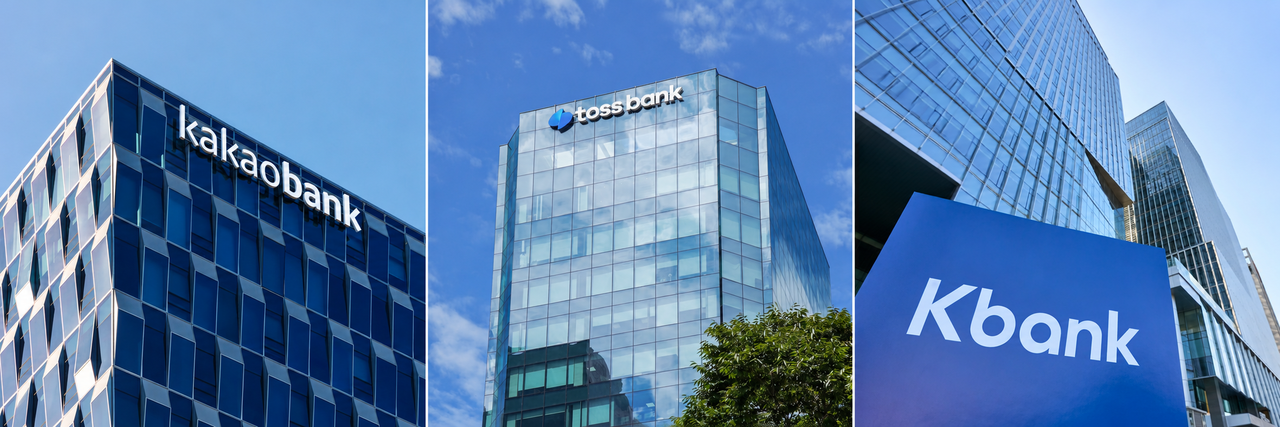
[Digital Today reporter Sangyeob Oh (오상엽)] South Korea’s three internet-only banks kept the share of outstanding loans to subprime borrowers above 30 percent in the third quarter this year. They are increasing loan supply by upgrading credit scoring models (CSS) using non-financial data, while also working to improve customers’ creditworthiness and ease the burden of high-interest loans.
According to third-quarter subprime loan results released by the three internet-only banks on Nov. 27, Toss Bank had the highest share of outstanding subprime loans at 34.0 percent. K Bank followed with 31.1 percent, and KakaoBank with 30.6 percent.
Based on new loan originations, K Bank was highest at 47.9 percent. KakaoBank and Toss Bank posted 36.3 percent and 34.1 percent, respectively. At Toss Bank, the share of new originations rose 1.4 percentage points from the previous quarter.
KakaoBank newly provided 510 billion won in loans in the third quarter to subprime individuals and individual business owners. Total supply through the third quarter this year was about 1.5 trillion won, and cumulative supply since its 2017 launch stands at 17 trillion won.
K Bank provided 356.6 billion won to subprime borrowers in the third quarter, bringing cumulative supply since launch to 9.38 trillion won. It supplied 708.7 billion won in private mid-rate loans through the third quarter this year, the highest among internet-only banks.
The internet-only banks are expanding the use of alternative credit scoring models to assess customers’ repayment capacity that was difficult to gauge using only traditional financial information.
Toss Bank runs its own credit scoring model (TSS) and nine specialized screening models that reflect spending tendencies, cash flow and payment histories. In the third quarter, 40 percent of subprime loan customers received credit score add-on points, and the share was 63 percent among young customers aged 19 to under 35.
KakaoBank has supplied an additional 1.3 trillion won in subprime loans since 2023 using its self-developed KakaoBank Score. About 13 percent of subprime loan transactions during the period were provided to customers who would have been difficult to approve under existing credit scoring models.
About 10 financial companies, including capital firms and savings banks, are also using KakaoBank’s alternative credit scoring model.
K Bank applied a credit scoring model for small business owners (SCB) that reflects sales, industry type and commercial districts to unsecured loans for individual business owners in September. It plans to provide about 150 billion won a year by offering preferential loan limits to small business owners with high business growth potential.
There were also confirmed cases in which subprime loans led to repayment of existing high-interest debt and higher credit scores.
In the third quarter, 50 percent of KakaoBank’s mid-credit loan customers saw their credit scores rise by an average of 47 points one month after loan execution. At Toss Bank, 49 percent of subprime loan customers posted an average credit score increase of 45 points over the same period.
Among customers who held unsecured loans from non-bank lenders, 31 percent at KakaoBank and 30 percent at Toss Bank reduced their outstanding non-bank loan balances one month after loan execution. The average reduction was 3.5 million won and 3.79 million won, respectively.
The banks are also expanding support for low-income finance and small business owners. Toss Bank supplied more than 1.4 trillion won in low-income financial products, including mid-rate loans and Haetsal loans, through the third quarter this year. K Bank launched the Ansim Account No. 4 for small business owners in Seoul, offering a loan limit of up to 20 million won and support covering 50 percent of guarantee fees.
A KakaoBank official said, "Beyond supplying loans, we are helping materially improve the creditworthiness of mid- and subprime customers and expanding the base of inclusive finance across the financial sector by spreading CSS know-how." The official added, "We will continue inclusive finance based on upgrading data-based credit scoring models and risk management."
 Sangyeob Oh
yub@d-today.co.kr
Keyword
#Toss Bank #K Bank #KakaoBank #CSS #TSS
