
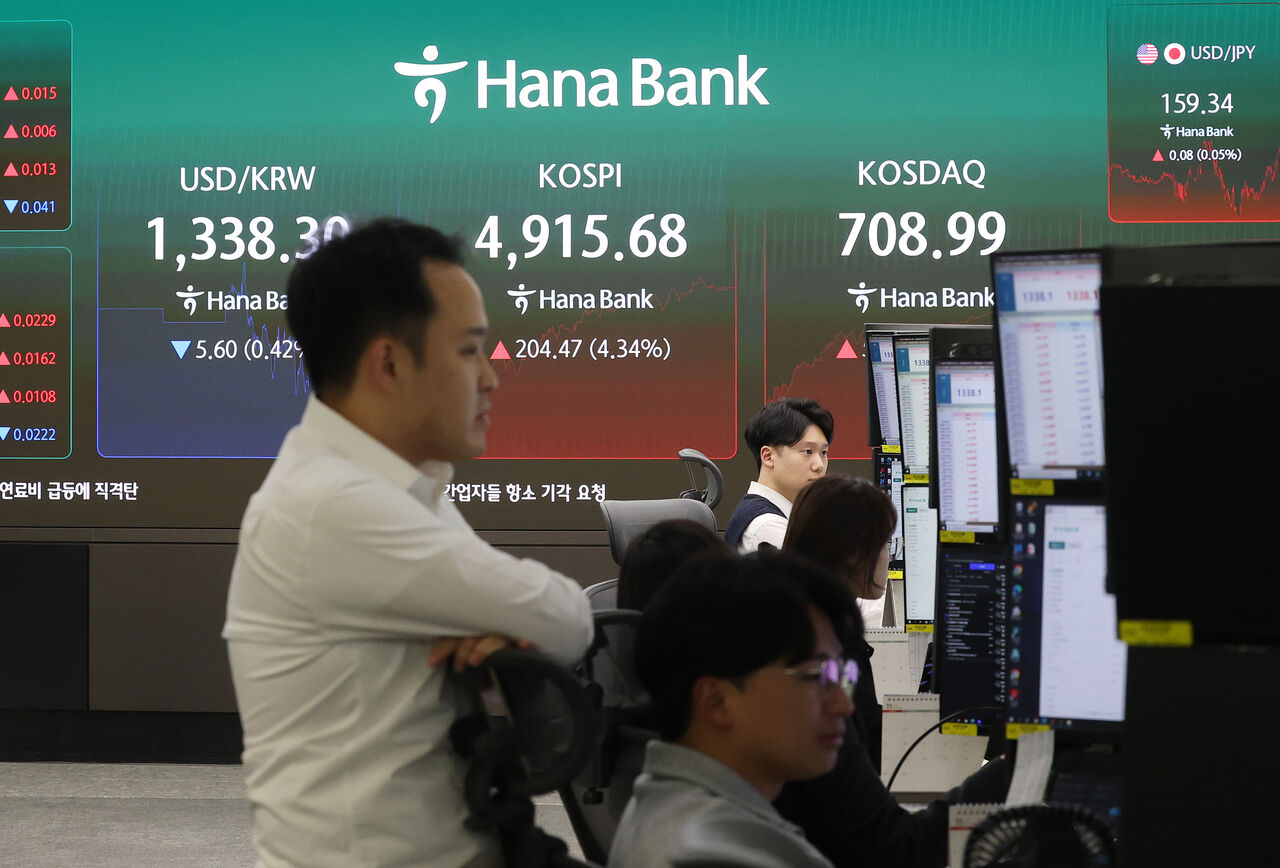
Domestic stocks rebounded sharply on expectations of an increase in the securities market stabilisation fund and on bargain hunting. The KOSPI recovered the 4,900 level and the Kosdaq surged more than 8 percent.
On Nov. 27, the KOSPI ended up 204.47 points, or 4.34 percent, at 4,915.68. The index opened up 17.59 points, or 0.37 percent, at 4,728.80, then briefly turned lower. It later extended gains and rose above 4,900.
By investor category, foreigners and institutions were net buyers of 1.13 trillion won and 238.8 billion won, respectively, leading the rise. Retail investors were net sellers of 1.77 trillion won.
Most of the top market-cap stocks rose, led by chipmakers.
Samsung Electronics closed up 4.55 percent at 179,100 won. SK Hynix ended up 5.41 percent at 1.11 million won.
SK Square gained 5.37 percent, LG Energy Solution 4.80 percent, Samsung Electro-Mechanics 4.72 percent, Hyundai Motor 3.86 percent, Celltrion 2.55 percent and Samsung Biologics 1.05 percent. KB Financial fell 0.21 percent.
The Kosdaq jumped 53.28 points, or 8.13 percent, to end at 708.99. As gains widened, a buy-sidecar was triggered at 10:22 a.m., halting the effectiveness of program buy orders for 5 minutes.
The Kosdaq's close above 700 was its first since Nov. 11 (705.10), after 12 sessions.
The won-dollar exchange rate was 1,338.60 won, down 5.40 won from the previous session.
Bargain hunting after a recent plunge, solid moves in U.S. stock index futures and expectations of an increase and activation of the stabilisation fund by financial authorities are seen as factors supporting sentiment.
The government began preparations on Nov. 22 to be able to activate the stabilisation fund immediately. It also held a joint meeting of related agencies on Friday to review progress in implementing stock market stabilisation measures. The market is also watching the possibility of increasing the existing stabilisation fund, which is in the 10 trillion won range.
Han Ji-young (한지영), a researcher at Kiwoom Securities, forecast before the market opened that the domestic stock market would continue its recovery, citing bargain hunting, solid moves in U.S. futures markets and expectations of an increase in the stabilisation fund.
Han said, "Until new supply and demand from the stabilisation fund comes in, the rebound's momentum could be limited by constraints on actual buying entities, but I think there is no need to approach this more pessimistically."
She also analysed that, with the KOSPI having fallen to the mid-to-high 4,000s, the selling burden is also growing for investors betting on further declines.
 Oh Sang-yeop
yub@d-today.co.kr
Keyword
#KOSPI #Kosdaq #Samsung Electronics #SK Hynix #Kiwoom Securities
