
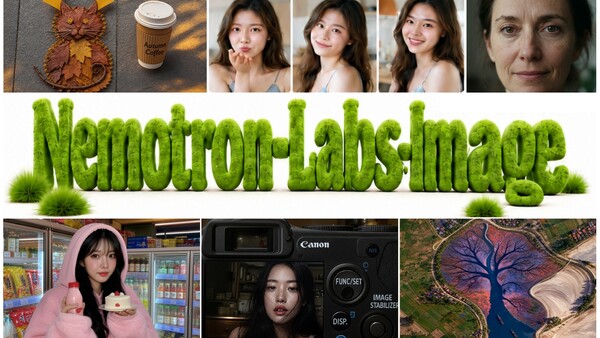
Nvidia has released for free an AI model that generates images in a way similar to large language models (LLMs). It uses an autoregressive method that differs from existing diffusion models. A system combining AI agents outperformed image generation models from OpenAI and Google in some performance evaluations.
On Nov. 27 local time, Japanese media outlet Gigazine reported that Nvidia published the model weights for its image generation AI model Nemotron-Labs-Image-30B-A3B through AI development platform Hugging Face.
The model is a core component of Nvidia's visual content generation framework Nemotron-Labs-VisualCreation. It was developed based on the company's in-house LLM, Nemotron 3 Nano. It has 30 billion total parameters and 3 billion active parameters.
Unlike existing diffusion models, which complete images by gradually removing random noise, the new model sequentially generates visual tokens the way an LLM writes sentences. It then converts them into images through a dedicated tokenizer. It can produce photos and illustrations, as well as images containing text and infographics.
Nvidia plans to support the creation of editable visual content beyond image generation, including webpages, presentations, documents and charts. It said it will release a code generation model for this, Nemotron-Labs-VisionCode, and a harness that controls overall tasks after completing legal review.
The performance of the full system, which combines AI agents, is also drawing attention. According to Nvidia's technical report, a system linked with GPT-6 scored 92.86 on GenEval, which evaluates image composition, surpassing GPT Image 2 at 89. On LongTextBench, which evaluates the ability to render text within images, it scored 97.98, topping GPT Image 2 at 96 and Google's Nano Banana Pro at 97.60.
In some evaluations, however, it lagged competing models, and there is a gap between the standalone performance of the released image generation model and the performance of the full system.
An official run example uses four H100 80GB GPUs in an environment with Linux, Python 3.12 and CUDA 13.0-compatible drivers. The model can be downloaded for free, but it can be used only for non-commercial research and evaluation purposes.
 Choi Jae-won
ittt_0801@d-today.co.kr
Keyword
#Nvidia #Hugging Face #OpenAI #Google #Nemotron-Labs-Image-30B-A3B
