
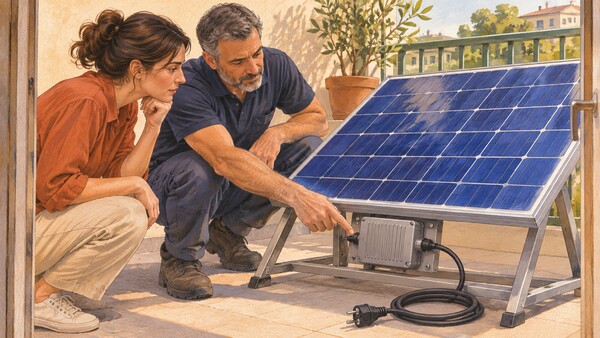
As legislation expands in the United States for plug-in solar that generates electricity by connecting to a household outlet, safety certification has emerged as a key task for market growth. Some point out that buyers should confirm not only whether individual components meet safety standards but also whether the entire generation system is certified.
An industry op-ed published on Cleantechnica on Nov. 26 (local time) said plug-in solar uses solar panels and a microinverter to supply power to a home's electrical circuit. It does not require large-scale rooftop installation work, which makes it usable for apartment residents and renters.
As of Nov. 22, 10 U.S. states including Utah, Maine and California have enacted laws related to plug-in solar. In 6 of those states the laws have taken effect, while the remaining 4 are awaiting implementation. New York state also passed related legislation in May but has not yet completed the governor's signing process.
Global safety certification body UL Solutions launched a plug-in solar system certification programme in January based on the safety standard UL 3700, which was released in December last year. It also released a revised version of the standard on Oct. 1.
Key assessment items include preventing electric shock and overload, cutting off power supply during outages and compatibility with residual-current circuit breakers. Evaluation covers not only microinverters but also connecting accessories and the overall system configuration.
Chinese solar inverter maker Hoymiles launched the HiFlow Pro microinverter, which meets UL 3700, in the U.S. market in July. The CSA Group also listed a HiFlow Pro system with a specific configuration, but it must meet designated components and installation conditions. The company expects to complete additional certification procedures for the full system next month.
The economics of plug-in solar vary depending on sunlight levels, electricity rates and household power consumption patterns. The U.S. federal government's residential clean energy tax credit also ended at the end of last year.
As a result, consumers should review the scope of certification for the full system, regional installation rules and the actual effect on electricity-bill savings before buying a product.
 Choi Jae-won
ittt_0801@d-today.co.kr
Keyword
#UL Solutions #UL 3700 #Hoymiles #HiFlow Pro #CSA Group
