
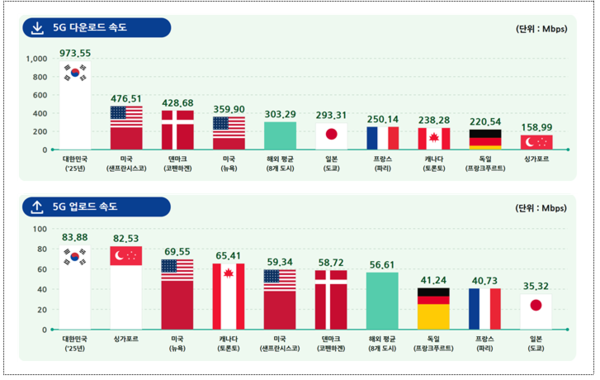
A survey found South Korea's 5G download speed is 3.2 times the average of major overseas cities. Telecommunications quality needed for services such as video conferencing and high-definition streaming was also higher than overseas levels.
The Korea Telecommunications Operators Association (KTOA) on Thursday released results of its "2026 Overseas Mobile Telecommunications Service Quality Survey", which measured 5G and public-place WiFi quality in eight cities across seven major countries.
Since 2012, KTOA has applied the same methodology used for South Korea's domestic telecommunications service quality assessment overseen by the Ministry of Science and ICT to examine telecom quality in major overseas countries. This year it surveyed New York and San Francisco in the United States, Toronto in Canada, Frankfurt in Germany, Paris in France, Copenhagen in Denmark, Tokyo in Japan and Singapore.
Meeting rate for high-definition streaming required speed at 98 percent, 29 percentage points above overseas average
From this year, KTOA included in its survey items the service-by-service required-speed fulfilment rate that was introduced in last year's domestic telecommunications service quality assessment. It examined not only data transmission speed but also how well required speeds were met for commonly used services including web browsing, short-form social media (SNS), video conferencing and high-definition streaming.
The results showed South Korea's required-speed fulfilment rate was higher than the average of major overseas cities in every category. For web browsing (at least 5 Mbps), South Korea recorded 99.81 percent versus 98.44 percent overseas, showing little difference. For SNS short-form video (at least 20 Mbps), South Korea was 99.46 percent, 6.76 percentage points higher than the overseas average of 92.70 percent.
The gap widened for services requiring higher transmission speeds. The fulfilment rate for video conferencing (at least 45 Mbps) was 99.01 percent in South Korea versus 83.16 percent overseas, a difference of 15.85 percentage points. For high-definition streaming (at least 100 Mbps), South Korea was 98.18 percent versus 69.16 percent overseas, a gap of 29.02 percentage points.
Among the overseas cities surveyed, San Francisco had the highest high-definition streaming required-speed fulfilment rate at 79.99 percent. Paris followed at 78.66 percent and Copenhagen at 78.30 percent. Singapore stood at 38.18 percent.
South Korea leads in 5G speed and latency; public WiFi also faster in South Korea
South Korea's average 5G download speed last year was 973.55 Mbps, about 3.2 times the 2026 average of 303.29 Mbps across eight major overseas cities. Among the overseas locations, San Francisco was fastest at 476.51 Mbps, followed by Copenhagen at 428.68 Mbps and New York at 359.90 Mbps.
South Korea's average 5G upload speed was 83.88 Mbps, about 1.5 times the overseas average of 56.61 Mbps. Average latency during data transmission was 21.66 milliseconds in South Korea and 58.47 milliseconds overseas, putting South Korea at 37 percent of the overseas average.
The share of 5G use switching to LTE also differed. South Korea's LTE switching rates during download and upload were 1.08 percent and 0.73 percent, respectively, lower than the overseas averages of 7.39 percent and 6.56 percent.
South Korea also led in public WiFi quality. South Korea's average public WiFi download speed last year was 400.48 Mbps, about 7.4 times the average of 54.20 Mbps in major overseas cities. Upload speed was 406.45 Mbps in South Korea versus 82.43 Mbps overseas, a gap of about 4.9 times.
The survey was conducted by activating Samsung Electronics' Galaxy S25 Ultra locally and using plans without speed limits. Quality was measured more than 50 times in major districts, outlying areas and subways in each city. The survey did not distinguish 5G frequency bands or service modes such as standalone (SA) and non-standalone (NSA), and excluded areas without telecommunications service from the statistics.
 Jin-ho Lee
jhlee26@d-today.co.kr
Keyword
#KTOA #Ministry of Science and ICT #San Francisco #New York #Samsung Electronics
