
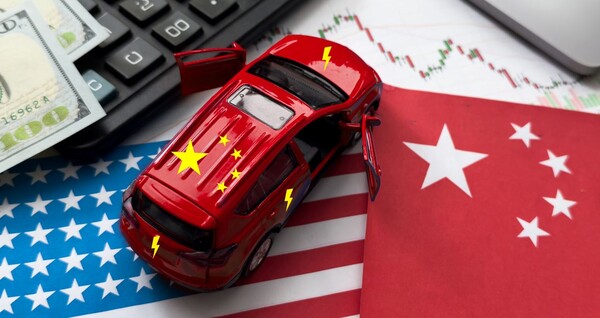
The U.S. Congress is stepping up efforts to pass a bipartisan bill restricting sales in the United States of connected vehicles linked to adversary countries such as China and Russia.
On Nov. 26, Business Insider reported that the Senate is seeking to pass the bill by voice vote in December, and the House is also discussing fast-track procedures. The chances of passage this year have increased after adjusting the text to reflect some concerns from the U.S. and European auto industries.
The Connected Vehicle Security Act, sponsored by Republican Senator Bernie Moreno (버니 모레노) and Democratic Senator Elissa Slotkin (엘리사 슬롯킨), centers on banning sales in the United States of connected vehicles that use parts and software from adversary countries. The two senators are aiming for a Senate voice vote in December, and the House is also pursuing fast-track procedures. Bipartisan Senate leaders have also been reported to have expressed support for the bill.
The increased likelihood of passage follows revisions to language reflecting concerns from U.S. and European automakers. People familiar with the talks said agreement has been reached on the core provisions, with only detailed wording left to finalize.
The bill originally would have barred U.S. sales of vehicles produced by companies with more than 15 percent Chinese ownership. That threshold posed a burden for Volvo, in which Chinese investors hold about 80 percent, and Mercedes, in which they hold 20 percent. Negotiations then focused on how to classify companies and vehicles as China-linked.
A revised version is expected to include more flexible standards for companies whose shareholders do not participate in management. Negotiators said that, as a result, Mercedes and Volvo would not be excluded from U.S. sales. Mercedes positively assessed constructive discussions with U.S. lawmakers, and Volvo reaffirmed its existing position that it had received separate approval to continue selling connected vehicles in the United States.
Unanimous consent is required to pass the bill by voice vote in the Senate. Support from Republican Senator Rand Paul (랜드 폴), who represents Kentucky, and Republican Senator Katie Britt (케이티 브릿), from Alabama where a Mercedes plant is located, is seen as a key variable. Paul previously pointed out that the Chinese ownership threshold unfairly targets Mercedes.
The battery itself is expected to be excluded from regulation. Some in the U.S. auto industry called for restrictions to include batteries and related technology, but that was not accepted in negotiations. The final version is expected to focus on battery management systems and not affect Ford's technology licensing cooperation with Chinese battery maker CATL.
The bill also includes a sunset clause. The move reflects concerns from some lawmakers that blocking low-priced Chinese electric vehicles indefinitely could slow decarbonisation.
Chinese electric vehicles are already subject to a 100 percent tariff, and U.S. Commerce Department restrictions on auto parts have also effectively limited access to the U.S. market. The bill also aims to codify those limits in law to reduce uncertainty for automakers as they draw up long-term parts procurement plans.
If passed, the bill is expected to further sharpen the U.S. Congress' hardline stance on China. With U.S. President Donald Trump mentioning the possibility of Chinese automakers building plants and selling vehicles in the United States, and the two countries also negotiating an extension of a trade truce set to expire on Jan. 10 next year, there are views that vehicle regulations could raise tensions between the two countries.
 Seung-a Yoo
ysah@d-today.co.kr
Keyword
#Connected Vehicle Security Act #Mercedes-Benz #Volvo #CATL #Rand Paul
