
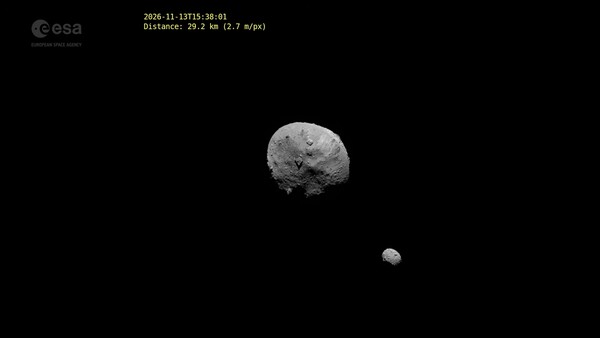
The European Space Agency's asteroid probe Hera has captured a huge crater and surrounding debris created by humanity's first asteroid orbit-change experiment. The findings are expected to improve the precision of planetary defence technology designed to artificially alter the trajectory of asteroids that could collide with Earth.
On Nov. 25, IT outlet Ars Technica reported that ESA released new images observed by Hera of the Didymos and Dimorphos binary asteroid system at the Museum of Natural History in Berlin, Germany.
The U.S. National Aeronautics and Space Administration on Sept. 26, 2022 slammed its DART spacecraft into Dimorphos at 6.14 km per second to test changing an asteroid's orbit. The impact shortened Dimorphos' orbital period by about 33 minutes.
Hera, launched in October 2024, reached its destination earlier this month after about two years of flight. Observations showed a stadium-sized crater on Dimorphos, which is about 151 metres in diameter, and that its rotational state also became highly unstable.
Patrick Michel (패트릭 미셸), Hera's project lead scientist, explained that crater formation and changes in the overall shape of the asteroid occurred at the same time.
Hundreds of rocky fragments were also found around the two asteroids. Further research is needed to determine whether the fragments were produced by the DART impact or are remnants left over from Dimorphos' formation process.
Earlier, NASA in March released research findings that the DART impact changed not only Dimorphos' orbital period but also the binary system's orbital period around the Sun by 0.15 seconds.
Hera is currently flying about 25 to 30 km from the two asteroids at an average relative speed of 12 cm per second. ESA plans to approach to about 13 km next month and then deploy the CubeSats Juventas and Milani in early January 2027.
Over the next roughly six months, it plans to closely analyse the asteroids' mass, composition and internal structure to identify the principles behind impact-driven orbital changes and boost the reliability of planetary defence technology.
 Jae-won Choi
ittt_0801@d-today.co.kr
Keyword
#European Space Agency #Hera #NASA #Didymos #Dimorphos
