
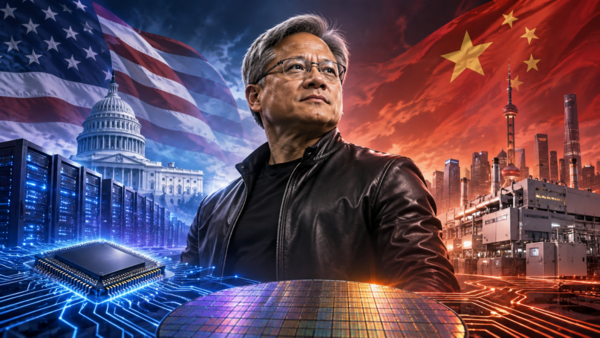
A recent controversy surrounding Nvidia CEO Jensen Huang has again focused the front line of U.S.-China technology competition on semiconductors and the China market.
On Nov. 26, Hong Kong's South China Morning Post reported that Nvidia's actions between U.S. semiconductor export controls to China and its China business have emerged as a new turning point in the technology conflict between the two countries.
At the core is that Nvidia has moved beyond being simply a semiconductor company to a symbolic position in the strategic competition between the United States and China. The United States is trying to block advanced artificial intelligence (AI) chips from flowing into China, while China is speeding up efforts to build its own semiconductor and AI ecosystem under such pressure. In this process, Jensen Huang's remarks, his visit to China, and Nvidia's stance toward the China market became subject to political interpretation.
Huang has repeatedly stressed the importance of the China market. He expressed the view that China is a "very important market" and warned that overly tightened U.S. export controls could only further spur Chinese companies to develop their own technologies. It exposed a point where U.S. national security logic and a company's global business logic collide head-on.
In the United States, the view has strengthened that Nvidia stands on the boundary between national security and industrial strategy. Nvidia's strategy of lower-spec chips for China was interpreted as an attempt to comply with regulations while not missing the market, but it also faced criticism that it could weaken the effectiveness of the controls. In China, by contrast, concern grew that U.S. rules are accelerating the rise of domestic technology capabilities.
Chinese companies are accelerating efforts to secure alternative supply chains and develop their own chips after access to high-performance U.S. chips was blocked. Chinese policy authorities are also pushing semiconductor self-reliance more strongly as a long-term task. Huang's remark that export restrictions could spur China to build an independent ecosystem aligns with this trend.
Market reaction also went beyond a simple corporate issue. Nvidia has established itself as a key supplier in the AI semiconductor market, but sensitivity around earnings and valuation increased as both the share of China revenue and U.S. regulatory risks were highlighted at the same time. Investors see Nvidia's growth potential as still large, while watching the possibility that uncertainty over its China business could persist if U.S.-China tensions become prolonged.
The issue is also raising questions about how the United States controls technology flows to China. A debate is flaring again over whether restrictions are effective in curbing China's advanced AI capabilities or instead speeding up China's push for domestically made technology. Huang publicly signalled a view that a global AI industry vision that excludes China is not realistic, showing a difference in tone from hardline U.S. arguments.
From China's perspective, the Nvidia case is being accepted as an example that shows the risks of dependence on U.S. technology. As it became clear that the supply of key components can be shaken by a single shift in U.S. policy, Chinese semiconductor companies, cloud companies and AI developers are more likely to further hasten efforts to secure alternative technologies.
Ultimately, the controversy surrounding Huang revealed the structural reality of U.S.-China technology competition beyond a dispute over a CEO's remarks. The United States is strengthening technology controls by putting security first, and China is pressing ahead with a self-reliance strategy as a result. Nvidia is being continually pressed to balance the importance of the China market with compliance, and future additional U.S. export restrictions and progress in China's domestic semiconductor development are expected to be the next variables in this dynamic.
 Jinju Hong (홍진주)
hongjj@d-today.co.kr
Keyword
#Nvidia #Jensen Huang #South China Morning Post #China #United States
