
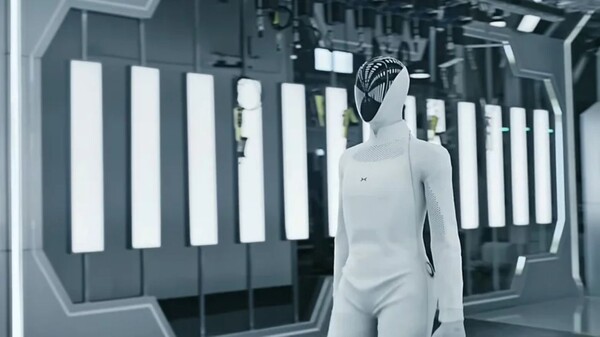
[DigitalToday Yoo Seung-a, intern reporter] Chinese electric vehicle (EV) maker Xpeng said it could consider entering the household market within 1 to 2 years, following the deployment of humanoid robots at commercial sites.
CNBC reported on Nov. 26 (local time) that Xpeng co-president Brian Gu (브라이언 구) said the company could consider placing household robots 1 to 2 years after successfully operating robots in commercial settings. He added that technological progress is faster than expected.
Xpeng unveiled its general-purpose humanoid robot, Iron, on Nov. 25. The company plans to start mass production in January 2027 and train Iron as store support staff at its car dealerships from the first quarter. Sales will begin from the second quarter and customer deliveries are expected within the year.
Xpeng is applying autonomous driving technology accumulated in its EV business to its robot business. It introduced driver-assistance functions earlier than Tesla in mainland China and also developed its own AI chips. It expanded its business into personal aircraft and robots. In the first fundraising for its robot business unit this summer, it raised $900 million led by IDG Capital, and its valuation was assessed at $6.3 billion.
Xpeng also announced a "Turing physical AI architecture" that controls vehicles and humanoid robots with artificial intelligence and real-time decision-making technology. Gu explained that the impact from U.S. restrictions on exports of Nvidia advanced chips to China is limited because the company can use its existing driver-assistance chips for robot development. He said there has been no change in the supply chain or its ability to secure chips.
Gu cited Xpeng's integrated capabilities across hardware, software and real-world use cases as a competitive strength. He stressed that the most difficult technical challenge is to organically run multiple functions so the robot can answer questions while walking or working, and avoid falling or losing focus. He said this differentiates it from many Chinese humanoid robot startups that focus on individual technologies such as hands or AI brains.
Gu said Xpeng co-founder and CEO He Xiaopeng (허샤오펑) also once thought software alone could solve every problem, but realised through the EV business how difficult it is to make hardware operate safely and consistently.
Profitability is also a key source of expectations. Gu projected that transferring autonomous driving technology to the robot business is relatively easy and that robot business profitability could be higher than that of the car business. He also said the robot business could grow into a major pillar of Xpeng's operations within 2 to 3 years and could generate profit as early as next year. He also expects to attract additional investors after Iron's commercial launch.
Still, hurdles remain for household robot commercialisation. Unlike commercial settings, robots must operate safely around older people, children and pets in homes and respond to emergencies. This raises requirements for battery performance and consistency of movement.
The market is also cautious. Xpeng shares have fallen more than 55 percent this year in New York and Hong Kong amid a slump in China's auto market and broader weakness in the sector. In China's humanoid industry, regulatory checks on fundraising have tightened after weak share performance following Unitree's initial public offering (IPO) and a concentration of funding in the industry. Proving the effectiveness of robot technology and the feasibility of actual commercialisation has emerged as a task for the industry.
 Yoo Seung-a
ysah@d-today.co.kr
Keyword
#Xpeng #Iron #Brian Gu #CNBC #IDG Capital
