
[DigitalToday reporter Jinju Hong (홍진주)] Europe’s largest satellite manufacturing plant has opened in Belgium. With Elon Musk’s SpaceX using Starlink to secure an early lead in the low-Earth orbit satellite communications market, the European Union is moving to build the production base needed for its own satellite network.
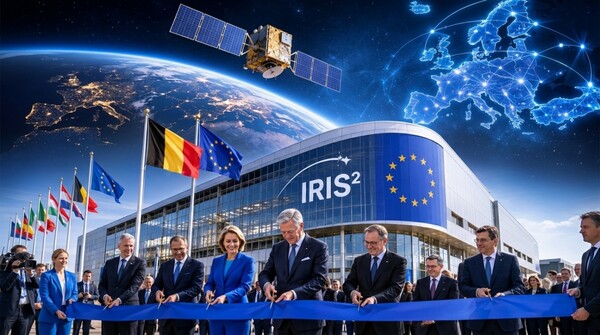
On Nov. 26 local time, CNBC reported that Belgian satellite manufacturer Aerospacelab opened a new satellite factory this week in southern Belgium. The facility is expected to serve as a key production base for IRIS², the EU’s low-Earth orbit satellite communications network.
Aerospacelab signed a 2.4 billion euro contract in September to produce 264 of the 348 satellites to be used for IRIS². IRIS² is a project Europe is pursuing to build its own satellite communications infrastructure in response to Starlink. The company said the project will become the backbone of Europe’s sovereign, secure and resilient connectivity infrastructure by 2030. Aerospacelab plans to change its name to Actro from Nov. 30.
The factory, unveiled at a completion ceremony attended by Belgium’s King Philippe, is oval-shaped and covers 20,000 square metres. Belgium’s royal palace said it is large enough to produce up to 500 satellites a year. If it operates as planned, it will become the world’s third-largest satellite production facility. Employees will move in sequentially from January next year, and actual production is set to start at the end of 2028.
Europe’s push to expand satellite production capacity is driven by the link between communications infrastructure and security. Satellite communications provide internet in areas beyond the reach of terrestrial networks and are also used for communications in defence equipment such as warships and fighter jets. They can also enable governments and militaries to communicate reliably when ground networks are cut or disrupted.
In particular, the war in Ukraine has highlighted the strategic importance of commercial satellite communications networks. Ukraine’s military has relied heavily on Starlink in responding to Russian forces. But after Ukrainian authorities said there were restrictions on Starlink service near Russian-occupied areas, concerns grew that communications infrastructure essential to national security could be affected by the policies and decisions of private companies.
Even so, it will not be easy for Europe to narrow the gap with Starlink in a short period. SpaceX currently operates more than 11,000 Starlink satellites in low-Earth orbit and plans to increase the number to as many as 100,000 over the long term. Rival operators are also accelerating network expansion. Amazon’s satellite communications business, Amazon Leo, has deployed more than 400 satellites and aims to build an initial constellation of more than 3,200.
In Europe, existing satellite communications operators are also taking part in building IRIS². French satellite communications company Eutelsat operates more than 600 low-Earth orbit satellites through the OneWeb constellation. Eutelsat, together with SES and Hispasat, is part of the SpaceRISE consortium, which is responsible for developing and operating IRIS².
The European Commission has defined IRIS² as a strategic asset to respond to commercial constellations such as Starlink and to secure Europe’s space sovereignty. In August, the commission announced with SpaceRISE that it would expand the flagship constellation from 282 satellites to 348. As a result, secure communications capacity for EU governments is expected to increase by 60 percent. The commission cited growing demand in defence and security as a major reason for the expansion.
The first IRIS² satellite launch is scheduled by the end of 2029, and the project aims to start initial services immediately after launch. The new Belgian factory is significant in that it has created a production base for Europe to reduce its reliance on U.S. commercial satellite communications infrastructure and build its own network. But with actual satellite production starting at the end of 2028, it is expected to take considerable time before the project delivers results in competition with Starlink.
 Jinju Hong
hongjj@d-today.co.kr
Keyword
#Belgium #IRIS² #Aerospacelab #SpaceX #Starlink
