
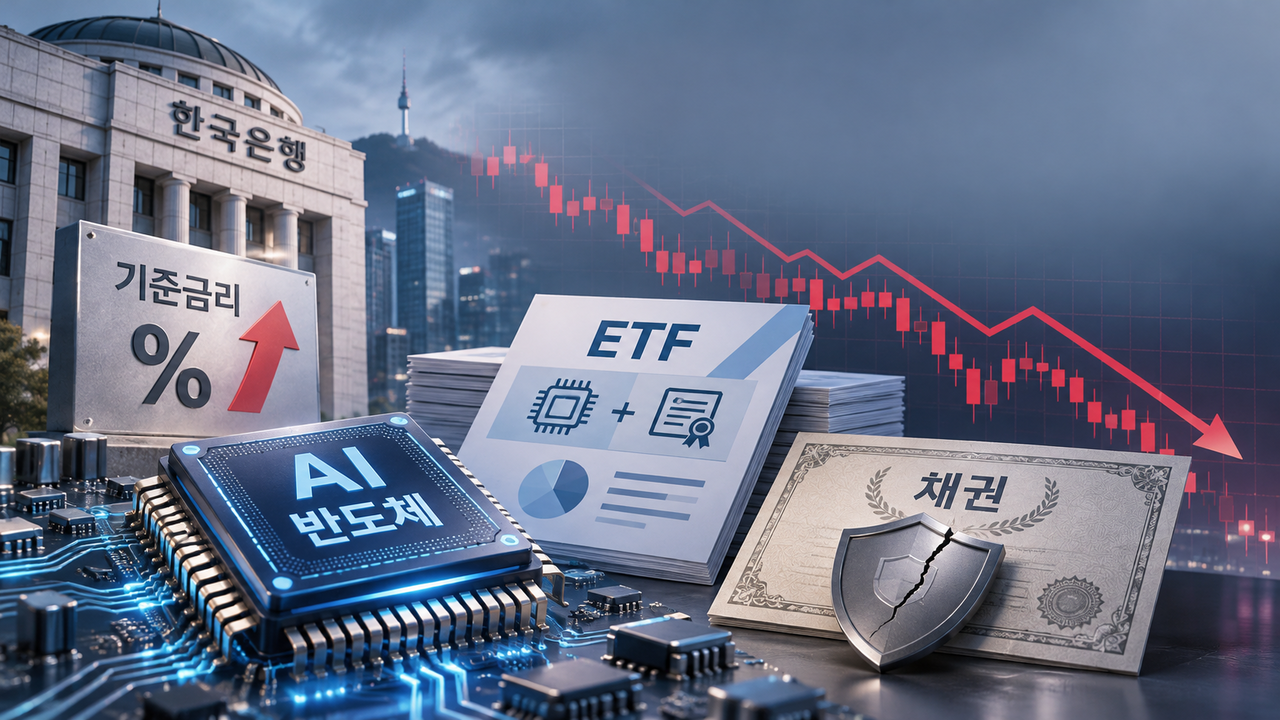
Exchange-traded funds that invest in artificial intelligence (AI) and semiconductors while also holding bonds are being launched in succession in the second half. The shift follows a sharp fall in tech stocks. With a recent rate hike, some assess that the loss-buffering ability of bond-mixed ETFs is now being put to the test.
According to the Korea Exchange on the 27th, 11 of 99 ETFs listed in the first half were stock-bond mixed products excluding target date funds (TDF), accounting for 11.1 percent of the total. In the second half, 14 of 64 newly listed ETFs through the 10th were mixed products, already exceeding the first-half total. Their share of all new products rose to 21.9 percent, about double the first-half level.
AI and semiconductor products, key investment themes in the ETF market this year, are also becoming more segmented. Previously, products mainly invested in major domestic and overseas semiconductor companies or global big tech. Recently, they have expanded into products that focus on specific areas such as materials, parts and equipment, and DRAM.
Products that also include major tech stocks such as Samsung Electronics, SK Hynix and Nvidia along with bonds have also emerged in succession. They target demand from investors seeking to invest in the growth potential of tech stocks while lowering volatility through bonds.
Competition among asset managers to get ahead in the retirement pension market is also cited as a factor behind the expansion in product launches. Defined contribution (DC) retirement pensions and individual retirement pensions (IRP) are, in principle, limited to a 70 percent allocation to risk assets. Bond-mixed ETFs that meet certain requirements can be invested up to 100 percent within the account.
In particular, the launch of bond-mixed ETFs that invest in Samsung Electronics and SK Hynix stood out. Major domestic asset managers introduced products in succession that combine the two stocks with domestic bonds or U.S. Treasuries.
This month, ACE Global Memory Semiconductor TOP3 Bond Mixed Active was listed on the 3rd. On the 10th, IBK Hyundai Motor Robotics Bond Mixed 50 and KODEX U.S. Nasdaq 100 U.S. Treasury Mixed 50 were newly listed, extending the stream of launches.
Still, as talk of an AI bubble spreads and semiconductor stocks plunge, bond-mixed products are also posting weak returns.
As of the 26th, an analysis of returns for 9 AI and semiconductor-related products listed this year among 52 bond-mixed ETFs showed both 1-month and 3-month returns were negative. The simple average 3-month return for those products was calculated at minus 17.61 percent.
The average return for 7 products that invest heavily in semiconductors was minus 19.66 percent, showing a bigger drop.
PLUS SK Hynix SanDisk Bond Mixed 50, listed in August, posted a 3-month return of minus 26.64 percent. TIGER Samsung Electronics SK Hynix U.S. Treasury Mixed 50 and ACE Samsung Electronics SK Hynix Plus Bond Mixed 50 recorded minus 19.41 percent and minus 18.63 percent, respectively.
KIWOOM Samsung Electronics & SK Hynix Bond Mixed 50 (minus 18.40 percent), KODEX Samsung Electronics SK Hynix Bond Mixed 50 (minus 18.22 percent), 1Q K Semiconductor TOP2 Bond Mixed 50 (minus 18.21 percent) and RISE Samsung Electronics SK Hynix Bond Mixed 50 (minus 18.12 percent) also posted similar losses.
Bond-mixed products that invest in U.S. tech stocks also could not avoid declines. 1Q Nvidia Alphabet U.S. Treasury Mixed 50 posted a 3-month return of minus 14.62 percent, while IBK U.S. AI TOP10 Government Bond Mixed 50 showed minus 6.20 percent.
Bond-mixed ETFs aim to reduce volatility compared with equity products by including both stocks and bonds. Still, if the stock allocation is concentrated in specific names or industries, it is difficult to avoid losses from a sharp stock drop even if about half is allocated to bonds.
The Bank of Korea raised its benchmark interest rate to 3.25 percent a year from 3.00 percent on the 26th, and changes are expected in asset managers’ ETF product strategies.
That is because the combination of a high-rate stance and greater stock market volatility could increase investment demand for bond-mixed products, while competition among asset managers over the retirement pension market continues.
A financial investment industry official said, "If the high-rate stance continues and stock market volatility also increases, investment demand may rise as investors seek to secure both upside potential in stocks and interest income from bonds." The official said, "The launch of bond-mixed ETFs is likely to become more active, and product strategies will also diversify, such as broadening the range of stocks included or combining short-term bonds that are relatively less sensitive to rate changes."
 Sang-yeop Oh
yub@d-today.co.kr
Keyword
#Korea Exchange #Bank of Korea #Samsung Electronics #SK Hynix #Nvidia
