
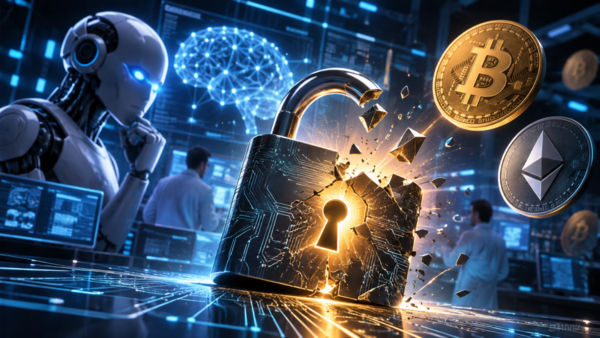
[DigitalToday reporter Jinju Hong] Major artificial intelligence (AI) research labs may have secured a major breakthrough in cryptography that has not yet been disclosed. As AI's mathematical reasoning advances rapidly, worries are growing that it could threaten the security underpinnings of cryptocurrencies such as bitcoin and ether. Still, it has not been confirmed that any real cryptographic system has been cracked.
Cointelegraph, a blockchain media outlet, reported on Nov. 26 that theoretical computer scientist Scott Aaronson (스콧 애런슨) wrote in a recent blog post that it was likely major AI labs had achieved one or more "bombshell" results in cryptography.
Aaronson, a former OpenAI researcher and a professor at the University of Texas at Austin, said he had heard signs of this from multiple reliable sources. "I'm virtually certain that the AI labs achieved major results in this area," he said.
He drew a line, saying he had not personally verified the specific research and had not heard an explanation directly from lab officials. That means there is no confirmed information on which cryptographic technologies were affected or whether the work reaches a level that enables real decryption.
The concern coincides with a recent series of AI-based breakthroughs in mathematical research. Levent Alpoge (레벤트 알포게), a mathematician at Anthropic, announced on Nov. 21 a proof of the generalized Riemann hypothesis with AI assistance. The problem is considered one of mathematics' leading difficult challenges.
Alpoge said he used an unpublished version of Claude to write about 17 million lines of Lean code over about 6 weeks. Lean FRO and the Mathlib Initiative then verified the proof.
Anthropic and OpenAI later each announced proofs related to the VP vs VNP conjecture, a hard problem in theoretical computer science. It is viewed as an algebraic analogue of the well-known P vs NP problem. In October, OpenAI released 722 AI-generated mathematics manuscripts on GitHub covering 372 problem areas, and the material is nicknamed "Mathocalypse."
Aaronson assessed the developments by saying, "The last week has looked and felt a lot like the beginning of the AI singularity as I've always imagined it." He meant that AI is increasing its speed in solving complex math problems faster than expected.
The point the industry is watching most closely is the relationship between integer factorisation and cryptographic systems. One of the rumours Aaronson heard was that 1 or 2 AI labs may have solved "Factoring in P." That would mean they found an algorithm that can perform factorisation in polynomial time.
If true, it could significantly affect the RSA cryptosystem, whose security is based on the difficulty of factoring large primes. AI commentator Andrew Curran (앤드루 커런) and Carnegie Mellon University machine learning researcher Aran Nayebi (아란 나예비) also said they had heard similar talk.
Still, that does not mean the security of bitcoin wallets has collapsed. Bitcoin uses ECDSA, an elliptic curve digital signature scheme, not RSA. Aaronson also said he could not confirm whether ECDSA has actually been cracked.
"The cryptography issue shouldn't obscure the intellectual scale of what's happening right now," he said. "If your biggest worry right now is your bitcoin wallet, then for rumours about whether ECDSA is broken, you should look elsewhere. I don't have that answer," he added.
Ethereum co-founder Vitalik Buterin (비탈릭 부테린) and researcher Justin Drake (저스틴 드레이크) also publicly raised in October the potential impact AI advances could have on cryptographic technology. As AI rapidly improves its ability to solve difficult mathematical problems, concerns are spreading that the safety of existing cryptosystems needs to be reviewed over the long term.
What is currently confirmed is the rumour that AI labs have secured major results in cryptography and the rapid progress in mathematics research. No evidence has been released that RSA or ECDSA has been broken. The key focus will be whether AI labs disclose related results and undergo independent verification, and what impact the results may have on the security of cryptographic technologies.
 Jinju Hong
hongjj@d-today.co.kr
Keyword
#Scott Aaronson #OpenAI #Anthropic #RSA #ECDSA
