
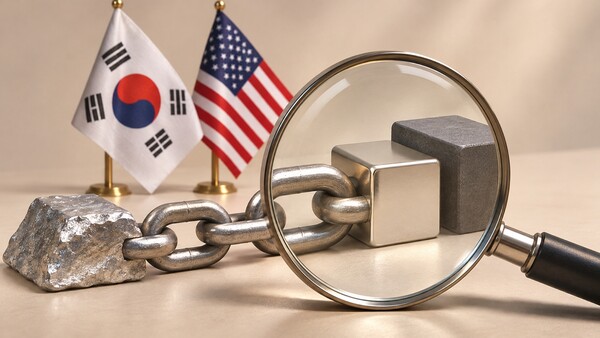
The United States will strengthen supply chain restrictions from 2027 on rare-earth permanent magnets used in the defence industry. As the scope expands beyond the country where finished products are made to include the mining and refining of raw materials, securing production bases and raw material supply chains to replace China is becoming more important.
A commentary by Evolution Metals and Technologies (EM&T) published recently in the U.S. defence and security outlet Breaking Defense said magnet procurement restrictions under the Defense Federal Acquisition Regulation Supplement (DFARS) will be tightened from Jan. 1, 2027, local time.
Previously, alloy melting and magnet production in China, Russia, North Korea and Iran were restricted. From next year, the rules will expand across the entire supply chain, including raw material mining, refining and separation. Neodymium-iron-boron (NdFeB) magnets and samarium-cobalt (SmCo) magnets are among those covered.
The International Energy Agency (IEA) said China accounted for 94 percent of global sintered permanent magnet output in 2024. With heavy reliance on China, U.S. defence contractors now face the task of verifying the origin of raw materials and their processing histories.
EM&T, a U.S. critical materials company, is expanding production facilities centered on Pohang, South Korea, and moving to secure non-Chinese rare earths. The company announced on the 29th of last month that it had secured supply volumes of about 754 tons of neodymium metal sourced outside China. Of that, 42 tons have arrived in Pohang, and 72 tons are scheduled to be shipped by March the following year. The remaining 640 tons have been contracted for supply by the end of the following year.
Third-quarter results materials released on the 16th said 57 containers of production equipment from Japan's ULVAC needed for the Pohang plant expansion have also all arrived, and trial operations are under way.
Once the expansion is completed, annual magnet production capacity is expected to increase to about 10,000 tons from 1,000 tons. Of that, capacity for high-performance sintered magnets is expected to reach about 6,000 tons.
EM&T has used Chinese materials for some civilian products. It plans to apply a separate raw material sourcing and production history management system to defence products, but whether it meets U.S. defence procurement rules and actual supply contracts are issues that require separate verification.
 Jae-won Choi
ittt_0801@d-today.co.kr
Keyword
#DFARS #Evolution Metals and Technologies #Pohang #International Energy Agency #NdFeB
