
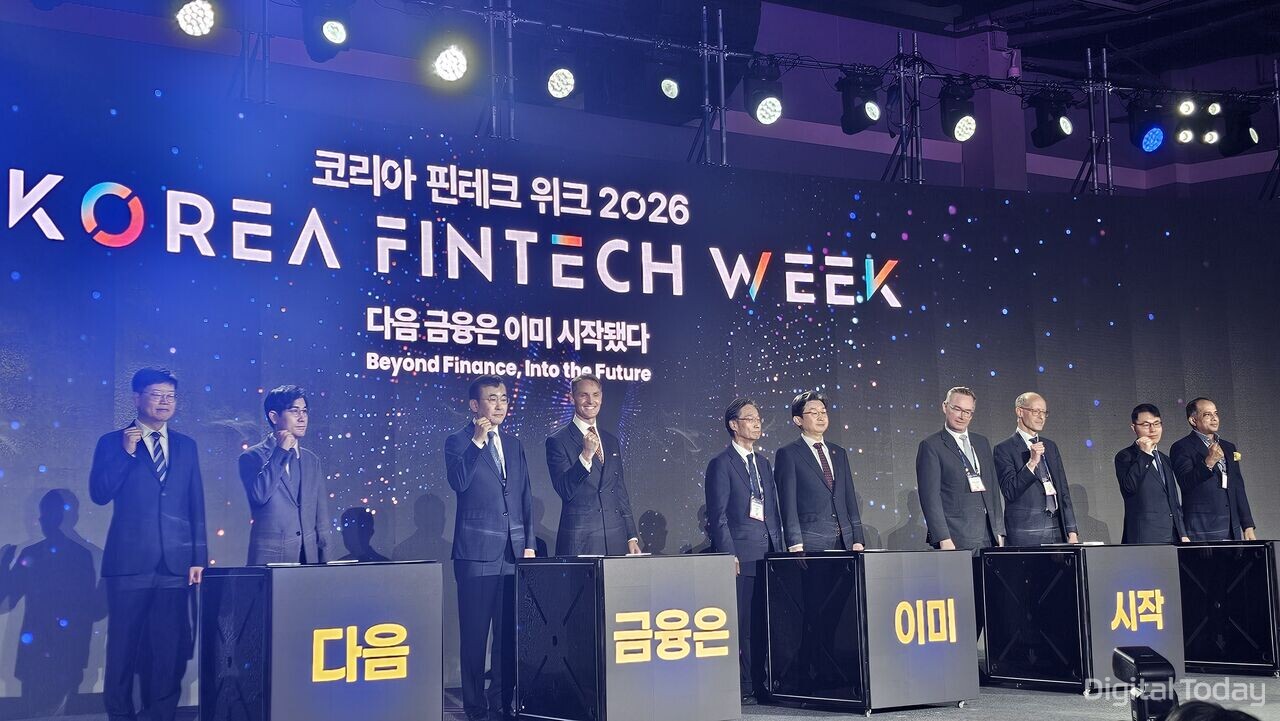
[Digital Today reporter Ji-young Lee] Korea Fintech Week 2026, the country’s largest fintech exhibition, opened at its largest scale yet. The event focuses on the future of the financial industry shaped by new technologies such as AI and blockchain. Financial authorities plan to speed up institutional improvements to support the financial sector’s AI transformation and to revitalise the digital asset market. Major financial groups and fintech companies also unveiled technologies and services aimed at future financial markets.
On Tuesday, the Financial Services Commission held the 8th Korea Fintech Week at the aT Center in Seoul’s Yangjae district under the theme, “Beyond Finance, Into the Future.”
The event runs for three days through Nov. 27. A total of 140 companies and institutions from South Korea and abroad are taking part, operating 115 exhibition booths. Organisers have also set up 36 programmes with about 120 speakers from South Korea and overseas.
Attendees at the opening ceremony included Financial Services Commission Chairman Lee Eok-won (이억원), National Assembly Political Affairs Committee Chairman Yoo Dong-soo (유동수), Financial Supervisory Service Senior Deputy Governor Lee Se-hoon (이세훈), Korea Fintech Support Center Chairman Kim Geon (김건) and Korea Fintech Industry Association Chairman Kim Jong-hyun (김종현), along with about 200 other domestic and overseas officials.
In a welcome address, Lee said, “It is time to boldly accelerate institutional changes that will underpin safe finance befitting a new era.”
Lee presented three policy directions for the development of the financial industry: integration of technology and finance, expanding inclusive finance using new technologies, and strengthening financial security.
He said the government will improve network separation and data-related regulations in the financial sector on the premise of sufficient safeguards, and will clarify standards for authority and responsibility arising from the use of AI. He also stressed that it will work for the swift passage of the digital asset law.
The government also plans to enhance alternative credit evaluation systems using AI and data, and to lower barriers to asset management services through AI agents, to improve financial consumers’ access to finance.
He stressed that the financial sector should speed up its AI transformation to respond to AI-enabled attacks, citing a series of recent security incidents in finance. He laid out plans to strengthen security capabilities through AI-based defence systems and zero-trust security design.
In a congratulatory address, Yoo also said the National Assembly will continue legislative and institutional support to improve unfair regulations between financial companies and fintech firms, and to support the fintech industry’s growth and overseas expansion.
Todd Fox, head of Visa’s (VISA) Institute for Economic Empowerment, and Kim Geon, chairman of the Korea Fintech Support Center, then delivered keynote speeches highlighting changes in financial services and new business opportunities driven by advances in AI, and the direction of fintech industry development in South Korea and abroad.
British Ambassador to South Korea Colin Crooks and Australian Treasury Assistant Secretary James Kelly also attended the opening ceremony and delivered congratulatory remarks.
◆ Four major financial groups gather, showcase AI-based future finance technologies
All four major financial groups — KB Financial Group, Shinhan Financial Group, Hana Financial Group and Woori Financial Group — took part in this year’s Korea Fintech Week, showcasing digital finance innovation technologies and services each group is pursuing. They introduced AI technologies used not only for future financial services but also in actual business operations.
KB Financial Group introduced future financial services combining AI and digital assets, including an AI-based financial service development environment, an AI assistant for financial consultation and overseas remittances using JPMorgan’s blockchain platform.
Shinhan Financial Group emphasised its AI-based asset management consultation service. Shinhan Bank’s asset management AI agent, introduced across all branches in January, analyses customers’ financial transaction histories, subscription status for investment products and mobile app usage patterns, and suggests customised consultation strategies to branch employees.
According to an on-site official, about 1,500 employees currently use the service consistently each week. The official said Shinhan Bank’s internal data comparison showed that employees using the service had a product sales probability about 2.5 times higher than those who did not.
Hana Financial Group organised its exhibition space around productive finance, inclusive finance and digital finance innovation.
It introduced products from a robotics company invested in by Hana Ventures, an AI-based service to find overseas buyers for small and medium-sized firms, and a policy finance product recommendation service. It also showcased an AI-based support system for loan screening used in actual business operations, and a future AI-agent payment model using stablecoins.
Woori Financial Group brought together AI services from Woori Bank, Woori Investment & Securities and Tongyang Life Insurance in one place. Woori Bank introduced an AI agent designed to improve work efficiency for corporate finance relationship managers. The system supports everything from analysing corporate information to recommending financial products and drafting loan proposals, allowing employees to focus on customer consultations.
Woori Bank first unveiled the system in September and plans to upgrade it by adding functions in December. It is currently reflecting employees’ feedback while starting to measure work efficiency and return on investment. Woori Investment & Securities introduced an AI-based investment platform, and Tongyang Life Insurance introduced an AI-based insurance coverage analysis service.
After the opening ceremony, Lee visited KB Financial Group and Woori Financial Group booths in person to review the digital finance technologies and services prepared by each group. He then visited booths of five companies and institutions: Travel Pass, Kakao Pay, Baekseok University, Lumos and BankSalad.
Kakao Pay provides a lifestyle finance platform spanning payments and remittances as well as investment, insurance and asset management. BankSalad provides personalised financial services based on MyData.
Fintech startup Lumos is developing a solution that uses AI to automate companies’ execution of government subsidies and related documentation and settlement work. Baekseok University introduced an educational curriculum that combines AI, financial engineering and blockchain technology, and its direction for training fintech professionals.
In addition, financial firms such as iM Financial Group, Industrial Bank of Korea and Samsung Card, and major fintech companies such as Viva Republica (Toss), Naver Financial, Hecto Financial, Kookon and Hanpass set up booths offering hands-on experiences and games for visitors, as well as AI-based future technologies.
During the event, seminars will continue on key issues in the financial industry, including AI agent-based payments, financial security, digital assets, open finance and banking sector digital innovation.
This year, the Global Finance & Technology Network, or GFTN, a global finance and technology cooperation network established by the Monetary Authority of Singapore (MAS), joined as a partner institution for the first time among overseas institutions. It will hold seminars on global financial innovation, AI governance and strategies for entering Asian financial markets.
The first day of the event focuses on digital finance policy. The second day will focus on fintech companies’ growth and investment attraction, and the final day will run various programmes centred on topics of interest to the general public, such as personal finance and employment.
 Ji-young Lee
ljy@d-today.co.kr
Keyword
#Korea Fintech Week 2026 #Financial Services Commission #KB Financial Group #Shinhan Financial Group #Kakao Pay
