
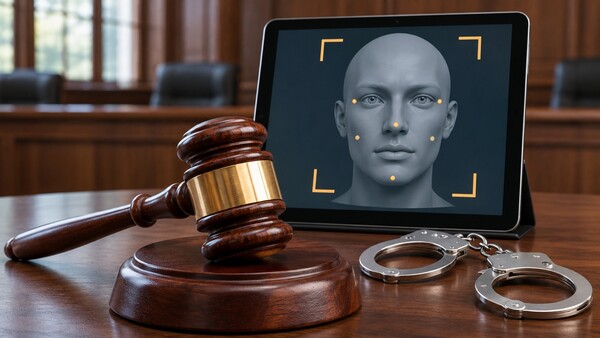
A U.S. federal court has ruled that arresting a suspect by relying only on AI facial recognition results could be unconstitutional. With law enforcement expanding its use of AI, the court pointed to concerns that investigations that place blind faith in technical judgments can violate individuals' fundamental rights.
On Nov. 23 local time, Japanese media outlet Gigazine reported that the U.S. District Court for the Eastern District of Kentucky rejected an immunity claim on Nov. 9 by Detective Ryan Kilmer (라이언 킬머), who is suspected of arresting an innocent citizen by relying on AI facial recognition technology.
The incident occurred in August 2024 at a bank in Florence, Kentucky. After a man trying to cash a check suspected of being forged left when a bank employee refused, police began an investigation based on surveillance camera footage.
Kilmer used AI facial recognition technology to compare the person in the footage with photos held by police and Facebook profile photos. He then identified Alain Vizcay Osorio (알랭 비스카이 오소리오), who lived in Nebraska, as the suspect.
Osorio was arrested in Florida in January last year and held for about 2 weeks. Prosecutors dropped the charges in May that year after he submitted evidence that he was working in Nebraska at the time of the incident.
Osorio filed a civil lawsuit against Kilmer in January this year, citing wrongful arrest and detention.
The court noted that the suspect in the surveillance footage and Osorio's photos showed significant differences in face shape and features, aside from skin color and facial hair. Internal guidelines at the Florence Police Department also stipulated that AI facial recognition results are only reference material for investigations and cannot serve as independent grounds for an arrest.
U.S. District Judge Chad Meredith (채드 메러디스) compared relying only on unverified AI judgments to the fortune-telling toy that provides random answers, the Magic 8-Ball. He stressed the need for independent judgment by investigative agencies.
The National Institute of Standards and Technology (NIST) has also previously analyzed that misidentification rates for facial recognition algorithms can vary depending on race, gender and age.
The decision allows the civil lawsuit to continue, but it does not determine the detective's final legal liability. Kilmer also denies claims that there was wrongdoing.
 Choi Jae-won
ittt_0801@d-today.co.kr
Keyword
#Kentucky #Florence #NIST #Facebook #Magic 8-Ball
