
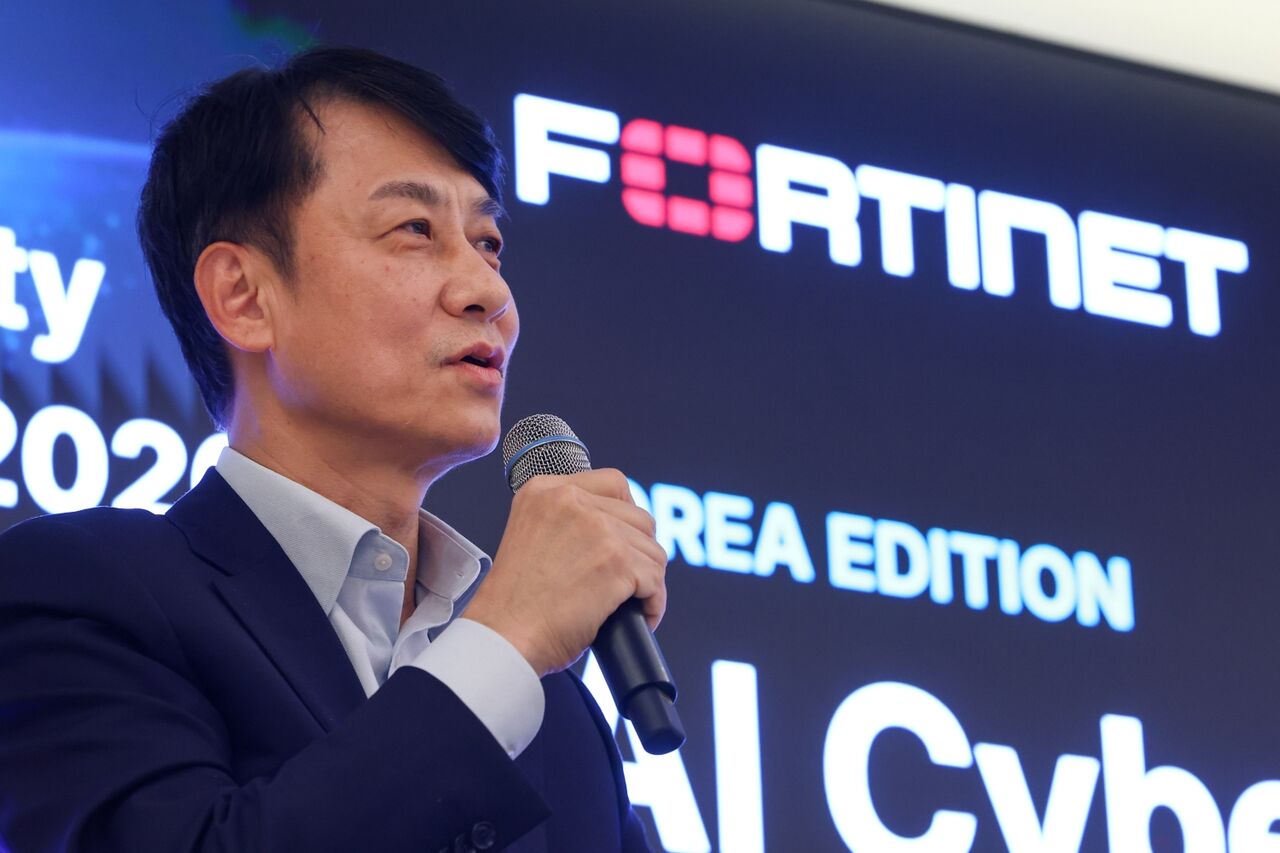
Global network security convergence solutions provider Fortinet Korea held the “AI Cybersecurity Summit 2026” on Nov. 24 at the Grand InterContinental Seoul Parnas, and presented the latest AI-driven attack trends and integrated security strategies for the AI era.
At the event, Fortinet shared how attackers are using AI to increase the speed and scale of attacks, and proposed ways to respond by connecting multiple security tools and AI into a single system.
Keynote speaker Daniel Kwong (다니엘 퀑), Fortinet’s North Asia field CISO, shared an outlook for attacks in 2027. He said AI agents’ long-term memory would become a target for persistent intrusion and prompt injection, and that plugins and third-party AI connectors would become key entry points in supply-chain attacks. He also forecast attackers would contaminate or manipulate telemetry and evidence referenced by AI security operations.
Daniel, the field CISO, pointed to “accidental architecture” as a problem in corporate security environments. He said as security tools from multiple vendors pile up and AI tools are added on top, the burden of integration, complexity and blind spots increase, ultimately raising risk.
He stressed that if firewall, endpoint and email AI systems each make judgments based only on the data they have, they can reach different conclusions about the same security incident, requiring analysts to coordinate the results themselves.
He presented an “AI-Native Security Fabric” as a solution.
The AI-Native Security Fabric is Fortinet’s integrated security platform that connects security products through a single operating system and a common data framework, with AI embedded within it. He said if the fabric links signals across multiple products and filters out duplication and noise to pass refined context to AI, the AI can make decisions and apply them consistently across the entire environment. He stressed that the quality of the context fed to AI, rather than the size of the AI model, determines the accuracy of decisions.
Kapil Gupta (카필 굽타), vice president of Fortinet’s security solutions division, said attackers are using AI to increase the speed and scale of attacks from malware development to phishing and vulnerability discovery. AI is also being used in actual attacks, including threat groups such as Kimsuky creating phishing lures with AI. He also introduced dark web trends identified through FortiRecon, saying AI services that do not filter harmful requests, AI-based attack-for-hire services and deepfake services are being traded on the dark web.
Kim Jong-deok (김종덕), head of Fortinet Korea, said, “AI is rapidly reshaping business and creating new risks along with opportunities.” He added, “As AI and security cannot be separated, I hope this summit served as a place to think together about security strategies for the AI era.”
 Chi-gyu Hwang
delight@d-today.co.kr
Keyword
#Fortinet Korea #AI Cybersecurity Summit 2026 #Accidental Architecture #AI-Native Security Fabric #Kimsuky
