
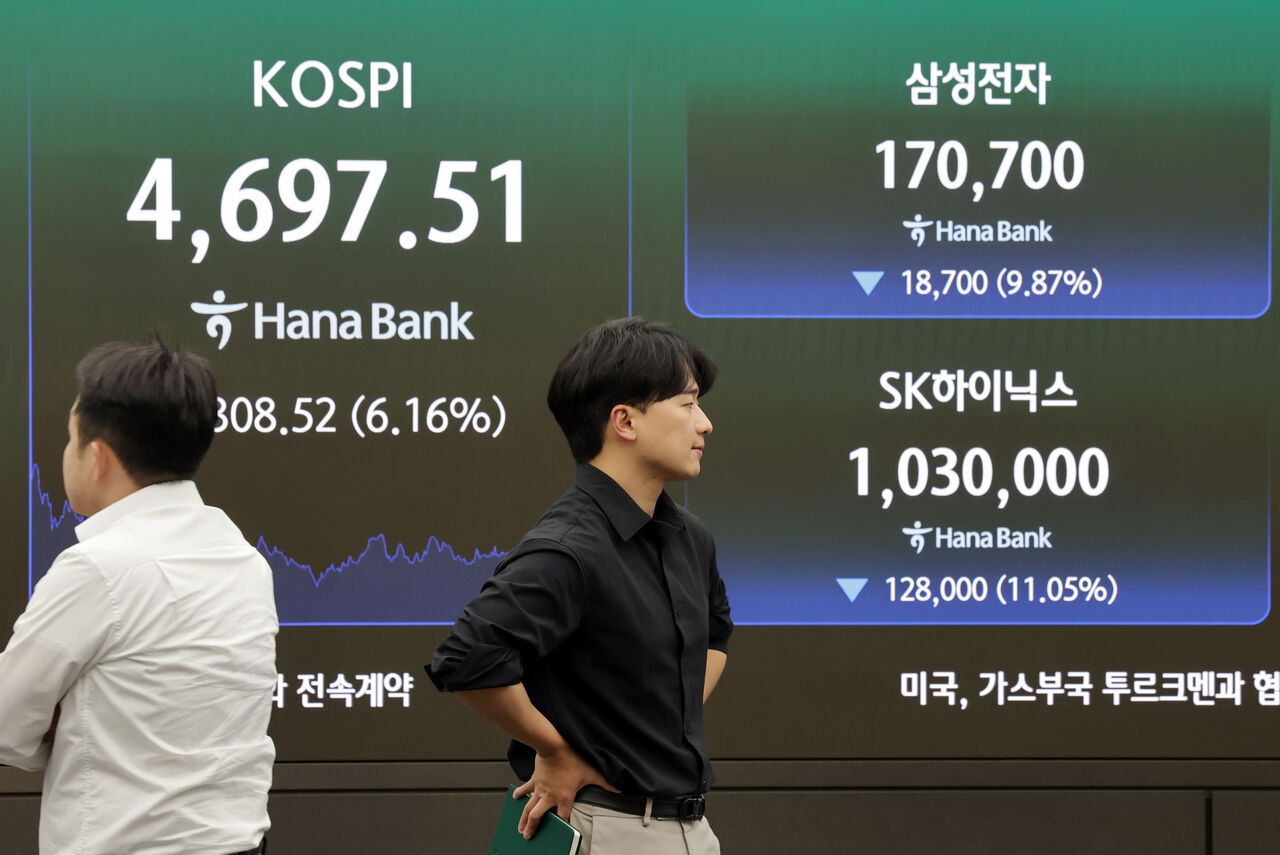
The KOSPI, which regained the 5,000 level a day earlier on the effect of Nvidia CEO Jensen Huang's return, slid back to the 4,600 level in one session. Renewed jitters in U.S. AI and semiconductor shares erased all of the previous day's gains.
On Tuesday, the KOSPI closed down 308.52 points, or 6.16 percent, at 4,697.51. The index opened down 197.03 points, or 3.94 percent, at 4,809.00, and a sell-side circuit breaker was triggered at 9:08 a.m. as program sell orders were temporarily halted.
By investor category, foreigners led the decline with net selling of 1.8993 trillion won. Retail investors bought a net 1.4224 trillion won, while institutions bought a net 100 million won.
Large-cap stocks by market value posted steep losses, led by semiconductor shares.
Samsung Electronics closed down 9.87 percent at 170,700 won and SK Hynix fell 11.05 percent to end at 1,030,000 won.
Samsung Electro-Mechanics dropped 12.00 percent and SK Square slid 11.19 percent. KB Financial Group fell 2.18 percent, Hyundai Motor lost 2.00 percent and LG Energy Solution declined 1.91 percent.
Samsung Biologics and Celltrion, however, rose 5.66 percent and 3.83 percent, respectively.
The KOSDAQ closed down 15.24 points, or 2.29 percent, at 650.64.
The won-dollar exchange rate was 1,343.30 won.
The KOSPI surged 6.32 percent a day earlier on the positive news of Huang's return, but it failed to extend the rebound as jitters over U.S. AI shares persisted and the Philadelphia Semiconductor Index fell more than 7 percent.
Han Ji-young (한지영), an analyst at Kiwoom Securities, analysed before the open that the previous day's stock rebound on Huang's return was only a partial recovery from last week's steep fall, and that challenges remain to be resolved for a full recovery in investor sentiment and a normalisation of supply and demand.
She cited major uncertainties including controversy over AI circular finance, deteriorating free cash flow among hyperscalers, and concerns about memory oversupply after 2028.
Han said: "Rather than interpreting the previous day's surge as a full-fledged signal of a trend reversal, it is necessary to recognise it as an initial phase in which pessimism that had excessively expanded over the past two months is beginning to retreat." She added: "At this point, what matters is how much the market can reverse the extreme pessimism, such as distrust in KOSPI earnings and the argument that valuation is meaningless, and recover from the sharp fall, rather than the possibility of further spread of existing negative factors."
 Sang-yeop Oh
yub@d-today.co.kr
Keyword
#KOSPI #Nvidia #Jensen Huang #Samsung Electronics #Philadelphia Semiconductor Index
