
South Korea's app market transaction value exceeded 10 trillion won. Global operators including Google and Apple led market growth, while One Store, South Korea's leading homegrown app market, shrank. Chronic problems persist, including developers' commission burdens, delays in app reviews and inconvenience for users cancelling subscriptions, raising questions about the effectiveness of regulators' policies.
According to the results of the "2025 App Market Market Status Survey" released on the 25th by the Korea Communications Commission and the Korea Internet & Security Agency (KISA), domestic app market transaction value last year was 10.59 trillion won, up about 9 percent from the previous year’s 9.68 trillion won.
By operator, revenue at Apple’s App Store rose about 15 percent, Google Play about 10 percent and Samsung Electronics’ Galaxy Store about 5 percent. One Store was the only one among the four surveyed operators whose revenue fell, down about 12 percent.
Korean app developers' revenue share was also concentrated in Google Play at 65.3 percent and the App Store at 26.5 percent, for a combined 91.8 percent. One Store and the Galaxy Store stood at 5.1 percent and 3.1 percent, respectively. The app markets users used most frequently were also concentrated in Google Play at 66.6 percent and the App Store at 30.0 percent.
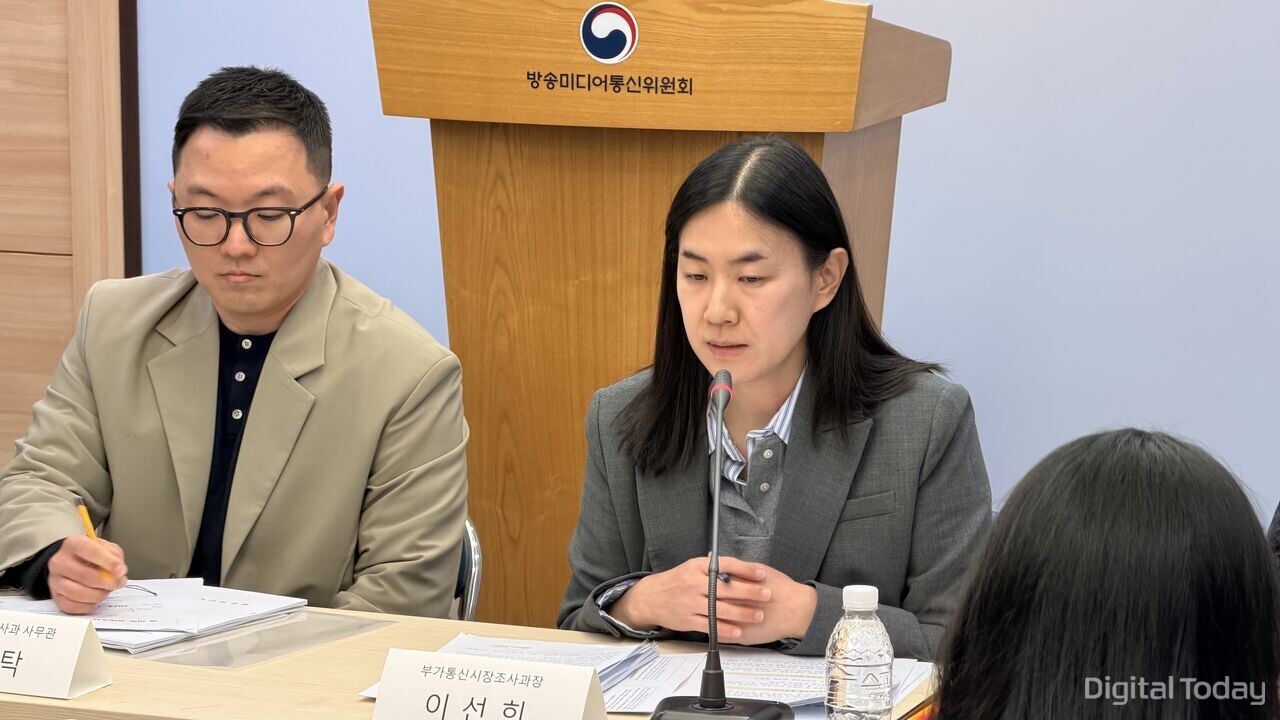
At a briefing on key policies by the Korea Communications Commission held at the Government Complex Gwacheon, some also pointed to the possibility that unfair practices by global app market operators widened gaps between domestic and foreign operators.
Lee Sun-hee (이선희), director of the Value-Added Telecommunications Market Survey Division at the Korea Communications Commission, said it was not possible to pinpoint the cause and that multiple factors should be considered, including the state of market competition and differences in content. If delays in regulators' investigations and handling had an effect, she said authorities would examine areas to improve during the process of implementing corrective orders.
With heavy dependence on global app markets, developers' commission burdens also persisted. Some 68.4 percent of developers cited fee burdens as a key problem with in-app payments, pointing to price hikes for content and services and customer churn due to commission burdens at 35.5 percent, and excessive commissions at 32.9 percent. The share of commissions relative to transaction value by app market was about 14 to 27 percent.
The app review environment worsened instead. The share of developers who experienced review delays rose from a year earlier for all four operators, with the App Store at 44.0 percent, Google Play at 30.8 percent, the Galaxy Store at 28.2 percent and One Store at 27.1 percent. The actual review period for an app's initial listing averaged 4.26 days, 1.59 days longer than developers expected at 2.67 days.
Concerns were also raised about app market operators using AI in reviews. While 42.5 percent of developers expected AI adoption to speed up reviews, 56.0 percent said they were concerned that AI might misinterpret app context and lead to review errors or rejections.
Lee said authorities were continuously monitoring commission and app review issues and would look into ways to improve review delays during the process of implementing existing corrective measures.
In terms of user protection, issues related to so-called dark patterns, including obstacles to cancelling subscriptions, were also identified. Some 46.7 percent said it was difficult to find the cancellation button or menu during the cancellation process for paid subscription services, while 30.3 percent said they had difficulties due to ambiguous notices about whether a cancellation was completed.
The Korea Communications Commission has conducted annual app market status surveys since 2022, following amendments to the Telecommunications Business Act in 2021 that banned forcing specific payment methods. This year it expanded survey items to include inconvenience in subscription cancellations, targeted advertising and AI-based app reviews.
The briefing did not present additional plans for institutional improvements or fact-finding on developers' commission burdens and review delays. It also did not offer separate measures to improve the competitive environment between domestic and foreign app markets.
The Korea Communications Commission first voted on Oct. 28 to impose a total of 63.7 billion won in penalties and issue corrective orders to Google and Apple, then sent the written decision to the two companies on the 23rd. Under the corrective orders, the companies must submit implementation plans within 1 month of receipt and complete improvement measures within 3 months. Taking the timing of the written decision into account, that is expected to fall in late next month and late February next year, respectively.
Lee said authorities would review the implementation plans and improvement details and then examine whether anything was lacking.
The Korea Communications Commission said it would work to ensure that a Telecommunications Business Act amendment bill aimed at regulating dark patterns, currently pending at the National Assembly’s Science, ICT, Broadcasting and Communications Committee, can pass within this year. The bill was discussed once in September at a bill review subcommittee.
As the app market grows quickly, the key question is whether regulators' fact-finding and sanctions will lead to tangible improvements in the transaction environment. Tasks remain, including ensuring the effectiveness of corrective orders against global operators and preparing follow-up policies to improve the competitive environment for domestic app markets and the rights and interests of developers and users.
 Seulgi Son
sageson@d-today.co.kr
Keyword
#Google Play #Apple App Store #Galaxy Store #One Store #Korea Communications Commission
