
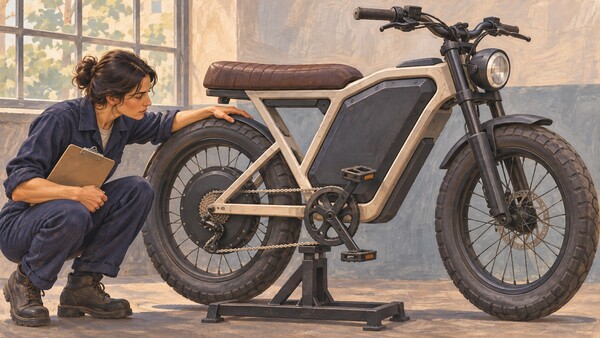
As competition heats up among e-bike makers to offer higher power output, the line between e-bikes and electric motorcycles is becoming blurred. Some point out that high-performance electric two-wheelers exceeding legal standards are being distributed as e-bikes, which could increase the risk of safety accidents and raise the regulatory burden across the industry.
On Nov. 23 (local time), Electrek pointed out that products touting 1,000 watts, 1,500 watts and 2,000 watts or more have been appearing in the e-bike market in recent years. It said competition among manufacturers is being reshaped around output figures, with products even featuring two electric motors.
In the United States, e-bikes are generally classified into three classes. For Class 1 and Class 2, motor assistance stops at about 32 km per hour, while for Class 3 it stops at about 45 km per hour. Motor output limits vary by state, but 750 watts is a common benchmark.
The problem is that some manufacturers sell products exceeding those standards as e-bikes. They also use methods such as labeling them for off-road use only or limiting speed through software. But fitting pedals or offering a speed-limiting function does not necessarily mean the vehicle is recognized as a legal e-bike.
Higher output does not necessarily mean better riding performance. Various factors determine real-world performance, including motor design, battery voltage, thermal management, power control and energy efficiency.
In the United States, related regulations are already being tightened. In September, California enacted a bill, SB 1167, restricting the labeling and sale of electric two-wheelers that do not meet legal e-bike standards as e-bikes. The law, which takes effect on Jan. 1, 2027, requires sellers to clearly inform consumers about vehicle classification and registration and licensing requirements.
New Jersey has also been applying driver’s license and vehicle registration requirements to low-speed e-bikes since July.
The outlet stressed, "There is no need to deny the utility value itself of high-performance electric two-wheelers, but a legal classification appropriate to the product’s performance and use is needed." It said that if indiscriminate output competition continues, even users of ordinary commuter e-bikes could be affected by tighter regulation.
 Jae-won Choi
ittt_0801@d-today.co.kr
Keyword
#Electrek #California #SB 1167 #New Jersey #Class 3
