
An AI robot has emerged that recreates a human skin-like touch, imitates breathing and precisely scans faces. It was developed to study how AI entering humans' physical space affects senses, psychology and the formation of trust.
On Nov. 25, IT outlet TechRadar reported that researchers at the University of Nottingham and arts group Blast Theory recently held a public prototype test of Facial Rover, an AI and robot-based interactive installation, in Dubai in the United Arab Emirates.
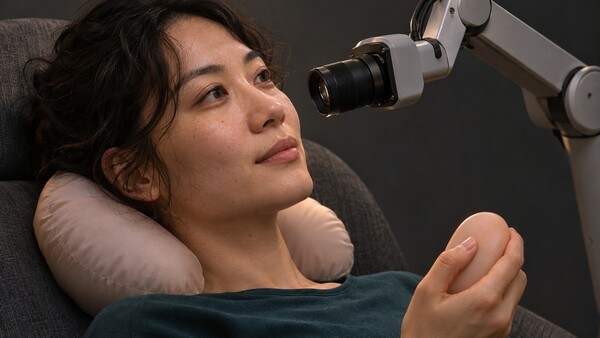
Facial Rover is a system that combines robotics, haptic technology, conversational AI and machine vision. When a participant lies on a dedicated chair in a darkened space, a high-magnification camera mounted on a robotic arm photographs the face at close range. It can observe details down to pores and hair in the skin and structures in the iris, and the AI generates a digital portrait that reinterprets the participant's face based on the collected visual information.
Participants can control the camera's movement with a controller that reproduces a temperature and touch similar to human skin. An air-inflated soft robot around the neck repeatedly expands and contracts like real breathing. The conversational AI communicates with the participant in a friendly voice and leads the experience.
Matt Adams (맷 애덤스), lead artist at Blast Theory, explained that exploring intimacy between robots and humans was the project's starting point. He said that as the AI observes a person at close range and speaks softly, participants can feel both being helped by the technology and a sense that the experience is being driven by it.
Researchers are examining how human attention is dispersed when multiple stimuli occur at the same time, including conversation, movement, visual input and touch. With a camera approaching within just a few millimetres of sensitive parts of the body, they also applied control algorithms that consider safety.
The prototype, completed last month, underwent public testing from Nov. 18 to 21 at the art exhibition STARS at Dubai Future Week. Researchers plan to improve the system based on participants' reactions and feedback and formally unveil it in 2027.
The research is expected to serve as an opportunity to explore new ethical issues, including protection of biometric information, privacy infringement and trust in robots, while expanding interaction between humans and AI into the physical realm.
 Jae-won Choi
ittt_0801@d-today.co.kr
Keyword
#University of Nottingham #Blast Theory #Facial Rover #Dubai Future Week #STARS
