
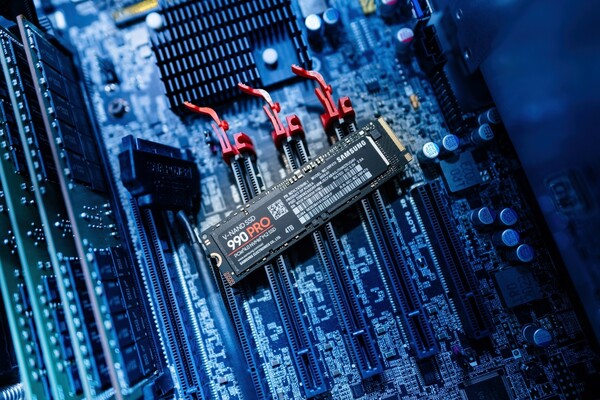
NAND flash prices are showing signs of entering a downturn. NAND spot prices have fallen about 20 percent in recent weeks, and there are forecasts they could fall through first-quarter 2027 contract prices. By contrast, DRAM, supported by demand for high-bandwidth memory (HBM) for artificial intelligence (AI) data centres, is expected to extend its gains. The memory market is splitting between consumer NAND and AI DRAM.
On Nov. 24, local time, IT outlet TechRadar reported that Bank of America (BoA) analysed the spot price for 512Gb NAND wafers at $14.30, down 12 percent from a week earlier and down 32 percent from the previous quarter. The price of 1Tb products also fell 19 percent to $24.90. BoA said NAND spot prices have adjusted about 20 percent since mid-October 2026 and forecast that commodity NAND contract prices in the first quarter of 2027 would fall an additional 5 to 10 percent.
Market research firm TrendForce issued a similar outlook. It said overall NAND contract prices in the first quarter of 2027 could fall 0 to 5 percent from the previous quarter. It forecast that from the second quarter of 2027, all product categories would enter a downcycle and the quarterly pace of price declines could increase.
Still, contract prices are still in an upswing for now. TrendForce lowered its forecast for this quarter's rise in NAND contract prices to 8 to 13 percent from a previous 15 to 20 percent. It reflected the possibility that price declines that appeared first in the spot market could spread to the contract market.
A simultaneous rise in supply and cooling demand is behind the larger drop. TrendForce projected NAND bit supply in 2027 would increase 25 to 30 percent. It also forecast industry capital spending would rise 26.7 percent from a year earlier to $29.9 billion. Wider adoption of QLC NAND and an increase in the number of stacked layers are also expanding supply by increasing the memory capacity that can be produced from a single wafer.
Demand, meanwhile, is weakening. Chinese cloud companies have reduced enterprise SSD orders in 2027 due to GPU shortages, high inventories and competition over AI token prices, the report said. It said the decline in orders from Chinese firms was larger than additional demand from U.S. hyperscalers.
The consumer market is also sluggish. PC sales contracted sharply in 2026, and smartphone and laptop makers are lowering storage-capacity specifications to cut costs. Commodity NAND used in smartphones and PCs is reported to be leading the recent weakness.
The supply structure of the NAND market is also cited as a factor fuelling price declines. There are 6 major NAND suppliers, making competition more intense than in the DRAM market, which is led in practice by 3 companies. About 20 to 30 percent of global NAND production capacity is tied up in older production lines not suitable for enterprise products, creating a structure in which supply of commodity products continues.
Still, demand for enterprise NAND used in AI data centres is reported to remain solid. That is widening supply-demand gaps between consumer and enterprise products even within the NAND market.
SSD prices felt by consumers are not expected to fall as quickly as spot prices. Spot trading is only a part of the overall market, and most transactions are based on contract prices. Distribution prices also move later than contract prices. Retail prices may only come under clear downward pressure once manufacturers and distributors run down inventory secured when prices were high.
The DRAM market is showing a different trend from NAND. TrendForce said that for the week through Nov. 17, mainstream DDR4 spot prices fell 1.43 percent to $44.25, but branded DDR5 prices were broadly stable. Contract prices are continuing to rise.
BoA maintained its forecast that DRAM prices would rise 8 percent in the fourth quarter of 2026 and increase 5 percent in the first quarter of 2027. TrendForce also expected DRAM contract prices to keep rising, although the quarterly pace of increases would slow. Mobile DRAM price negotiations, however, are being delayed as branded manufacturers take a wait-and-see stance.
AI-focused HBM is the key factor supporting DRAM prices. TrendForce researcher Ellie Wang (엘리 왕) said at a Seoul roadshow on Nov. 18 that HBM consumes 3 to 4 times more wafer resources than commodity DRAM. Because expanding HBM production limits resources that can be allocated to commodity DRAM, it will be difficult to expect DRAM prices to fall in 2027, she said.
New capacity is expected to flow into the market in earnest only after late 2027. Timelines for the start-up of Samsung Electronics' Pyeongtaek P5 and SK Hynix's Yongin cluster were presented as 2028 to 2030. That is why there are views that supply shortage pressure could continue for the time being.
Comments from memory makers also show concerns about supply shortages. Micron CEO Sanjay Mehrotra (산제이 메흐로트라) said 75 percent of its 2027 supply volume has already been sold. SK Hynix also warned shortages could continue through 2030. Apple’s John Ternus (존 터너스) also assessed current memory prices as being at an unprecedented level. DRAM revenue rose 369 percent from a year earlier in the third quarter, but bit shipment growth was limited to about 4 percent on a quarterly basis. That shows rising prices are driving revenue growth.
The direction of NAND prices going forward is expected to be affected by the speed at which Chinese cloud companies run down inventories, changes in overseas GPU procurement regulations, and adjustments to storage-capacity specifications by smartphone and PC makers. If policy changes after U.S. midterm elections affect approvals for AI data centre projects scheduled for 2028, pre-buying demand in the second half of 2027 could increase again.
Suppliers' responses are also a variable. If they slow the pace of capacity expansion or reduce wafer starts in line with weak consumer demand, the magnitude of NAND price declines could be limited. Conversely, if smartphone makers build inventories to buy cheaply, this price adjustment could be short-lived. Ultimately, the memory market in 2027 is expected to show a clear polarisation trend, as price-down pressure from rising commodity NAND supply and slowing demand intersects with DRAM supply shortages supported by AI-driven HBM demand.
 Jinju Hong
hongjj@d-today.co.kr
Keyword
#NAND #DRAM #TrendForce #Bank of America #HBM
